Beyond "Pick a Target": How to Build Practice Sessions That Actually Change Your Game
This one's for the serious golfer. You already know to aim at something. Here's the deeper playbook — session structure, fatigue management, practice transitions, net work, and the science of why most range sessions are wasted time.
- Structure beats volume every time — A 45-minute session with a warm-up, focused block work, variable practice, and a cool-down will outperform two hours of mindless ball-beating. Research on deliberate practice consistently shows that quality and intentionality drive improvement, not bucket count.
- You should be switching game areas more often than you think — Contextual interference research shows that mixing skills (called interleaved or "random" practice) produces worse performance during practice but significantly better retention and transfer to the course.
- Fatigue is a real enemy, and most golfers don't recognize it — Physical fatigue degrades swing mechanics within 60-90 balls. Mental fatigue erodes decision-making and focus even earlier. The moment your practice stops being intentional, you're training bad habits.
- Net practice at home is valuable — but requires a different approach — Without ball flight feedback, you need to shift your focus to contact quality, body position, and movement patterns. Done right, net work is an underrated tool for building swing changes.
- Every session needs a purpose written down before you start — "Hit balls" is not a practice plan. "Work on low-point control with 7-iron using the towel drill, then 20 minutes of lag putting" is a practice plan. The difference in outcomes is enormous.
A Note Before We Start
We write content for golfers at every level — from the person who just picked up the game to the single-digit player chasing scratch. This article is deliberately aimed at the golfer who wants to practice at a higher level. If you're the type who actually thinks about your practice, who wants to get more from every hour you spend at the range or on the putting green, this is for you.
That doesn't mean you need to be a low handicapper. A 20-handicap who practices with intention will improve faster than a 10-handicap who mindlessly pounds drivers. What matters is the willingness to approach practice as a skill in itself — something you can get better at, not just something you do between rounds.
Let's build a framework for how to actually practice.
Why Most Practice Sessions Fail
Here's the honest truth about what happens at most driving ranges: a golfer buys a bucket, pulls out their driver, hits balls until they stripe one, then moves to irons, hits balls until they stripe one, then leaves feeling good. That's entertainment, not practice.
The fundamental problem is that range performance and course performance are different skills. On the range, you're hitting the same club from the same lie to the same target with no consequences. On the course, every shot is a different club, a different lie, a different target, with real consequences. If your practice doesn't bridge that gap, you're training yourself to be a great range player — and a frustrated course player.
Research by K. Anders Ericsson — the psychologist who pioneered the study of deliberate practice — established that improvement in any skill domain requires practice that is focused, effortful, and targeted at specific weaknesses [1]. Ericsson found that simply accumulating hours of practice doesn't predict expertise. The quality of those hours does. In his framework, deliberate practice has four characteristics: it targets a specific weakness, it operates at the edge of current ability, it includes immediate feedback, and it involves high concentration.
How many of your last ten range sessions hit all four of those criteria?
Myth: "The more balls I hit, the better I'll get."
Reality: Volume without structure trains inconsistency. Research shows that after roughly 60-90 full-swing shots, physical fatigue begins degrading your mechanics — meaning the last third of a large bucket may be actively reinforcing bad patterns [2]. More isn't better. Better is better.
The Anatomy of an Effective Practice Session
Every productive practice session has the same basic architecture, regardless of what you're working on. Think of it as five phases: warm-up, technical block work, variable/transfer practice, competitive games, and cool-down reflection. The time you spend on each phase will vary, but skipping any of them reduces the value of the entire session.
Phase 1: The Warm-Up (10-15 Minutes)
This is not optional, and it's not just hitting wedges to "loosen up."
A proper warm-up has two components: physical preparation and calibration. Research from the Titleist Performance Institute (TPI) and studies published in the Journal of Strength and Conditioning Research show that a dynamic warm-up — not static stretching — increases clubhead speed, improves contact quality, and reduces injury risk [3]. One study found that dynamic stretching resulted in carry distance increases of up to 17 yards compared to a control group that skipped the warm-up entirely [4].
Physical warm-up (5-7 minutes):
- Arm circles and torso rotations — wake up the rotator cuffs and thoracic spine
- Hip circles and lateral lunges — activate the glutes and hip flexors
- Club-behind-the-back rotations — take a club, hold it across your shoulders, and rotate back and through slowly, increasing range with each rep
- Progressive swings — start with half-swings at 50% effort, gradually building to full swings
Calibration (5-8 minutes):
- Hit 5-8 wedge shots to establish contact and feel the ground
- Hit 3-5 mid-irons to calibrate distance and trajectory
- This is not practice — this is establishing your baseline for the day. Some days you'll feel sharp. Other days, things will feel off. The calibration phase tells you what you're working with so you can adjust your session accordingly.
If you arrive at the range feeling stiff, tight, or just "off," that's valuable information. Don't fight it. Adjust your practice to be more feel-oriented and less technically demanding. Some of your best practice sessions will come from working within your constraints on a given day rather than forcing an agenda your body isn't ready for.
Phase 2: Technical Block Work (15-25 Minutes)
This is where most golfers spend all their time, and it's where you do your most focused, deliberate work on a specific skill. Block practice means hitting the same type of shot repeatedly — same club, same target, same intent — to groove a specific movement pattern or make a technical change.
Block practice has a bad reputation in motor learning circles because it creates an inflated sense of progress. You hit 20 7-irons in a row and the last five are pure, so you feel great. But research consistently shows that block practice produces faster initial performance gains that don't transfer well to the course [5].
That doesn't mean block practice is useless. It means it has a specific purpose: building a new movement pattern or drilling a specific mechanical change. When you're working on something new — a grip change, a different ball position, a swing path adjustment — block practice is the right tool. You need repetitions of the same movement to build the neural pathway.
The key is knowing when to stop. Here's the rule: when you can execute the skill correctly three times in a row with intention, move on. You're not trying to hit 50 perfect 7-irons. You're trying to build the pattern reliably enough that you can find it under variable conditions.
Block practice should continue until you can execute the target skill correctly three consecutive times with full intention — meaning you went through your pre-shot routine, committed to the shot, and produced the desired result. Once you hit that threshold, additional block reps have diminishing returns. Move to variable practice where you test the skill under changing conditions.
Phase 3: Variable and Transfer Practice (15-25 Minutes)
This is where the real learning happens, and it's the phase most golfers skip entirely.
Variable practice — also called interleaved, random, or contextual interference practice — means changing the task on every shot or every few shots. Different clubs. Different targets. Different shot shapes. Different lies if you can find them. The goal is to simulate the decision-making environment of actual golf.
The research on this is overwhelming. A landmark study by Shea and Morgan (1979) established the contextual interference effect: learners who practiced multiple skills in a random order performed worse during practice but significantly better on retention and transfer tests compared to learners who used blocked practice [6]. This has been replicated across dozens of motor learning studies, including golf-specific research.
Why does this work? Because random practice forces your brain to actively reconstruct the motor plan for each shot. When you hit the same club ten times in a row, your brain goes on autopilot — it stops actively planning the movement. When you switch clubs every shot, your brain has to engage with each swing individually, building stronger and more flexible motor representations.
Practical variable practice formats:
- Play the course: Pick a hole you know, hit driver, then hit the approach club you'd actually use, then imagine the chip or putt. Move to the next hole. This is the gold standard of transfer practice.
- 9-shot game: Hit a low draw, a straight shot, and a high fade with three different clubs. Nine shots, nine different challenges.
- Random club selection: Lay out 4-5 clubs. Before each shot, pick one at random (or use an app). Hit to a specific target with whatever club fate gives you.
- Worst-ball drill: Hit two shots with the same club. Your next shot must be the harder of the two scenarios — the shorter one, the one in a tougher position.
Variable practice will feel frustrating at first. You'll hit fewer "good" shots than you do during block practice. That's the point. Your brain is doing harder work, and harder work produces deeper learning. Trust the process. If every shot in practice feels easy, you're not practicing — you're performing.
Phase 4: Competitive Games (10-15 Minutes)
Pressure changes everything about golf, and if your practice never includes pressure, you're leaving a massive gap between the range and the first tee.
Competitive practice means creating consequences for your shots — even artificial ones. The goal is to raise your heart rate slightly, engage your focus fully, and force you to commit to each shot as if it matters.
Range games that create pressure:
- Par 18: "Play" 9 holes from the range. Each hole is a specific target with a par based on difficulty. Keep score. Try to break par.
- 21: Hit shots to various targets. Greens hit = 3 points, close misses = 1 point, complete misses = -1 point. Race to 21.
- The Ladder: Hit one shot each with PW, 9, 8, 7, 6, 5. If you miss any target, start over from PW. How far up the ladder can you get?
- Last Ball: With three balls remaining, pick three specific targets. You must hit all three. This simulates the pressure of a shot that "counts."
Putting green games:
- Gate putting: Set two tees just wider than your putter head, 2-3 feet in front of the ball. You must roll the ball through the gate. This trains start line, which is responsible for roughly 83% of directional accuracy on putts under 8 feet [7].
- Lag putting challenge: From 30+ feet, try to get every putt within a 3-foot circle. Three in a row inside the circle completes the challenge.
- Scoring zone circuit: Place balls at 3, 5, 8, 12, and 20 feet. One attempt each. How many do you make? Track over time.
Phase 5: Cool-Down and Reflection (5 Minutes)
This is the most underrated five minutes of any practice session.
Hit 3-5 easy shots with a comfortable club — your go-to iron, a smooth wedge. End practice with good feelings and good contact, not with the frustration of whatever you were grinding on.
Then take two minutes to note three things:
- What was the focus of today's session?
- What felt better by the end than at the start?
- What's the one thing to work on next time?
This reflection doesn't need to be elaborate. A note on your phone is fine. But the research on learning is clear: reflection consolidates motor learning and helps the brain prioritize what to retain [8]. A session without reflection is a session that fades faster.
When to Switch: The Art of Practice Transitions
One of the hardest skills in practice is knowing when to move on. Stay too long on one thing and you're grinding past the point of productive return. Move too quickly and you never get deep enough to make a change stick.
Here are the signals that tell you it's time to transition:
Signs You Should Move to a New Area
- You've hit your "3-in-a-row" threshold — You can execute the skill reliably. More reps won't add much.
- Your attention is wandering — If you catch yourself hitting balls without going through your pre-shot routine, you've been on this station too long.
- You're chasing a different problem — You started working on ball position but now you're thinking about your grip. That's a sign your brain is looking for novelty. Give it something productive.
- Physical discomfort is creeping in — Sore hands, tight back, achy shoulders. Your body is telling you to change the movement pattern.
- You're getting worse, not better — If your last 10 shots are worse than your first 10, fatigue or frustration has taken over. Move on.
Signs You Should Stay a Bit Longer
- You're on the verge of a breakthrough — Sometimes you can feel it. The pattern is almost there. Give yourself another 5-10 focused reps.
- You haven't reached your 3-in-a-row yet — If the skill is new and you haven't been able to execute it reliably, stay with it. But set a time limit (10 more minutes) to prevent grinding.
- You're in a flow state — Rare and valuable. If you're deeply focused and the work feels challenging but achievable, ride that wave.
A Practical Transition Framework
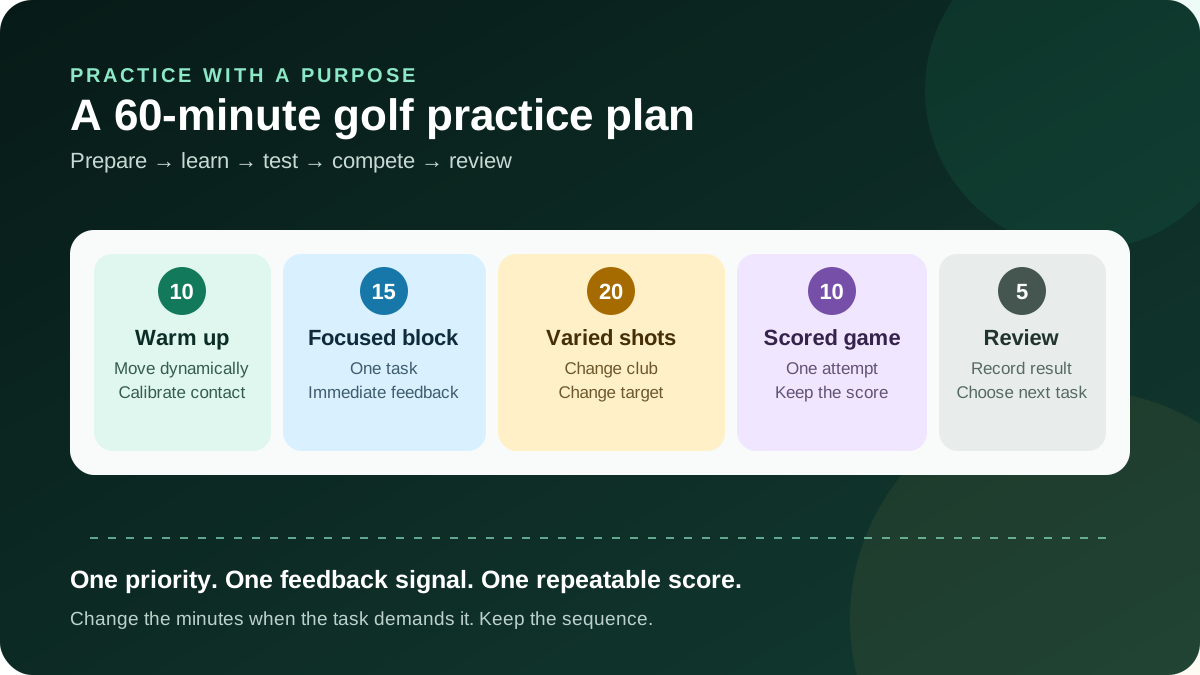
For a 60-minute session, here's a reasonable structure:
| Phase | Time | Focus | Transition Signal |
|---|---|---|---|
| Warm-up | 10 min | Physical prep + calibration | Body feels ready, contact is clean |
| Block work | 15 min | One specific technical focus | 3-in-a-row achieved, or 15 minutes up |
| Variable practice | 15 min | Random clubs, targets, shot shapes | Attention starting to fade |
| Competitive game | 15 min | Scored challenge with consequences | Game completed or frustration rising |
| Cool-down + reflection | 5 min | Easy shots + notes | Session complete |
Notice something about that table? Only 15 minutes — a quarter of the session — is dedicated to the block repetition that most golfers spend their entire practice doing. The rest is transfer, competition, and reflection. That ratio is deliberate.
Stop Pounding Balls: Understanding Practice Fatigue
This might be the most important section of this article. Fatigue — both physical and mental — is the silent destroyer of practice quality, and almost nobody talks about it.
Physical Fatigue
The golf swing is an explosive athletic movement. A typical driver swing generates peak muscle activation comparable to a 75-80% maximum voluntary contraction in the core and trunk muscles [9]. That's a significant physical demand, and it accumulates.
Research on golf-specific physical fatigue has shown measurable changes in swing mechanics after extended practice:
- Clubhead speed decreases — as muscles fatigue, you can't generate the same speed. You compensate unconsciously, altering your swing path and timing.
- Contact quality degrades — tired forearms and hands lead to inconsistent face control. The shots that felt solid in your first 30 balls feel thin or heavy by ball 80.
- Posture collapses — fatigue in the core and lower body shows up as early extension, loss of spine angle, and poor weight transfer. These aren't swing flaws — they're fatigue symptoms.
- Injury risk increases — most range-related injuries happen in the second half of a session, when tired muscles can't protect joints and connective tissue.
For most amateur golfers, meaningful physical fatigue begins setting in after 60-90 full-swing shots. This varies based on fitness level, age, swing speed, and conditions — a physically fit 30-year-old may handle more than a 60-year-old with a bad back. But the principle is universal: there's a point where additional balls are training tired-body mechanics, not your real swing. Pay attention to where your threshold is, and respect it.
Mental Fatigue
Mental fatigue is even more insidious because you can't feel it the way you feel sore muscles. A systematic review published in International Journal of Sports Science & Coaching (2025) examined how mental fatigue affects golf performance and found significant impairments across multiple skill categories — particularly putting accuracy and decision-making [10].
Here's what mental fatigue looks like in practice:
- Shortened pre-shot routines — you stop going through your full process and just hit
- Reduced target awareness — you're aiming "out there" instead of at a specific target
- Mechanical focus drift — you start the session working on one thing and end up thinking about three different things simultaneously
- Emotional reactivity — a bad shot triggers frustration that compounds into a string of bad shots
- Going through the motions — you're hitting balls but you're not really practicing anymore
The research on mental fatigue in golf found that it progressively worsens throughout extended activity — and unlike physical fatigue, it's not solved by a quick break. Once mental fatigue sets in, the quality of your attention is compromised for the rest of the session [10].
Here's a simple self-check: before every fifth shot, ask yourself, "What am I working on right now?" If you can't answer immediately and specifically, you've crossed into junk practice territory. Either refocus with a clear intention or end the session. There is no "I'll just hit a few more." A few more unfocused reps are worse than none.
How to Manage Fatigue Intelligently
- Set a ball count, not a time goal. "I'll practice for an hour" leads to grinding. "I'll hit 60 full-swing balls with full intention" keeps you honest.
- Alternate between high-effort and low-effort skills. Follow a block of driver swings with putting. Follow iron work with chipping. Give the full-swing muscles time to recover while you still practice productively.
- Take real breaks. Sit down. Drink water. Look at something other than your target. Even a 3-minute break between phases allows some neural recovery.
- Front-load your hardest work. Do your most technically demanding practice first, when you're freshest. Save the comfortable, feel-good work for later in the session.
- Track your drop-off point. Over several sessions, note when your focus and quality start declining. You'll probably find it's earlier than you think. That's your real session length — everything beyond it is optional at best and counterproductive at worst.
Practice Net Sessions: Making the Most of Zero Ball Flight
Home practice nets have exploded in popularity, and for good reason — they remove the biggest barrier to practice, which is time. But they introduce a real challenge: you can't see where the ball goes. And for many golfers, that feels like practicing blind.
It's not. It's actually an opportunity that most golfers waste.
What You Gain by Losing Ball Flight
When you can't see the ball fly, something interesting happens: you're forced to pay attention to the things that actually matter most. Contact quality. Body position. Tempo. Sound. Feel.
On the range, most golfers watch the ball, see a decent shot, and assume their swing was good. The ball flight becomes a crutch — it tells you what happened, but it hides why. A pushed 7-iron that lands on the green because you aimed left gets filed as a "good shot," when it was actually a compensated miss that won't work when you need to aim at a pin on the right side.
In a net, all you have is the swing itself. And that turns out to be enormously valuable for certain types of practice [11].
What Net Practice Is Good For
- Swing changes and technical work — When you're changing your grip, adjusting your takeaway, or working on a new move, ball flight is actually a distraction. You need to feel the change, not judge the result. Net practice strips away the result-orientation and keeps you focused on the process.
- Contact quality — With a piece of impact tape (or even athletic tape) on your clubface, you get immediate feedback on where you're striking the ball. Consistent center-face contact is the single biggest factor in distance and accuracy. You don't need to see the ball fly to train this.
- Tempo and rhythm — A net is perfect for tempo work. Use a metronome app, count in your head, or play tempo-matched music. You'll develop more consistent timing in your net than you ever will on the range, because you're not distracted by results.
- Volume of reps for new patterns — When you're building a new movement pattern, you need repetitions. Lots of them. A net lets you get those reps in 20-minute sessions between meetings instead of driving to the range.
- Slow-motion and partial swings — Half swings, three-quarter swings, and slow-motion reps build body awareness. These feel pointless on the range because the ball doesn't go far. In a net, there's no ego attached to distance.
What Net Practice Is NOT Good For
- Distance calibration — You can't practice distance control without seeing where the ball lands.
- Trajectory and shot shape — While you can feel the difference between a draw and a fade at impact, you can't confirm it without flight.
- Variable practice — The "play the course" style of practice doesn't work in a net because you can't assess the outcome of each shot.
- Short game touch — Chipping and pitching are almost entirely about distance feel. A net removes the feedback you need.
Making Net Sessions Productive
Use impact tape religiously. Put tape on the face before every session. After 5-10 shots, check the pattern. A consistent mark near center means you're making solid contact. Dispersed marks tell you something is off. This is your primary feedback mechanism [11].
Film yourself. Set up your phone on a tripod or propped against something stable. Record from two angles if possible: face-on and down-the-line. Watch after every 10-15 shots. This replaces ball flight as your feedback loop. If you're working with an instructor, these videos are worth their weight in gold.
Use alignment aids. Lay an alignment stick or club on the ground to check your setup every session. In a net, it's easy to gradually shift your alignment without realizing it, because there's no target line giving you visual feedback.
Limit full-speed swings. Net practice is ideal for 70-80% effort swings. You're building patterns, not chasing speed. Save the full-speed work for the range where you can see the result.
Focus on sound. A solid strike sounds different from a thin or fat one. Train your ears to recognize the compression sound of clean contact. Over time, you'll be able to assess your strike quality by sound alone — a skill that transfers directly to the course.
The biggest mistake golfers make with home nets is treating them like the range — standing there and hitting ball after ball with no focus. Because there's no ball flight to watch, practice without intention feels pointless (because it is). Before you hit a single ball into your net, write down what you're working on. One thing. If you can't name it, don't hit.
Where to Spend Your Practice Time: What the Data Says
If you tracked where you lose strokes relative to a scratch golfer, you'd probably be surprised. Most golfers assume they need to putt better or chip better. The data says otherwise.
Mark Broadie's strokes gained research — now the foundation of how the PGA Tour analyzes performance — found that shots outside 100 yards account for roughly two-thirds of the scoring difference between golfers of different skill levels [12]. Approach shots (iron play into greens) are the single largest differentiator. Tee shots rank second. Short game and putting, while important, have smaller differentials than most golfers assume.
Shot Scope data from millions of amateur rounds confirms this pattern: approach shots are where golfers lose the most strokes, and the gap widens as handicaps increase [13].
| Skill Area | % of Scoring Differential | % of Typical Practice Time | Mismatch |
|---|---|---|---|
| Approach shots (100+ yards) | ~40% | ~30% | Under-practiced |
| Tee shots | ~25% | ~40% | Over-practiced |
| Short game (inside 100 yards) | ~20% | ~15% | Under-practiced |
| Putting | ~15% | ~15% | About right |
Look at the mismatch. Most golfers spend their range time beating driver — the club they use 14 times per round at most. Meanwhile, approach shots (the 6-iron into a par 4, the wedge from 120 yards, the hybrid into a par 3) get relatively little dedicated practice despite being the single biggest opportunity for improvement.
Your practice time should be allocated roughly in proportion to where you lose the most strokes — not where you enjoy practicing the most. For most mid-to-high handicappers, this means more iron and wedge work, less driver, and dedicated short game time that actually matches its importance. If you're tracking your stats (and you should be), your data will tell you exactly where to spend your time.
That said, there's an important nuance: the area where you'll see the fastest improvement isn't always the area where you lose the most strokes. Short game improvements tend to show up faster because the skills involved (distance control, touch, green reading) can be trained relatively quickly. Long game improvements take longer because they often involve swing changes that need time to groove.
A reasonable split for a golfer who practices 3 times per week: two sessions focused primarily on full swing (with short game warm-up/cool-down) and one session dedicated entirely to short game and putting.
The Structure of a Short Game Session
Short game practice gets its own section because it requires a fundamentally different approach than full-swing practice. The skills are different, the feedback loops are shorter, and the opportunities for game-like practice are much greater.
Putting Practice (20-30 Minutes)
Speed first, line second. Distance control accounts for the vast majority of three-putt avoidance. Spend 60% of your putting practice on lag putting (20-40 feet) and only 40% on short putts. This is the opposite of what most golfers do [14].
Lag putting drills:
- Zone putting: Place a club or towel 3 feet past the hole. Every putt must stop between the hole and the club. This trains the "die speed" that gives the ball the best chance of dropping.
- Distance ladder: Hit putts to 20, 30, 40, and 50 feet. After each, hit back from where the ball stopped. This builds feel for varying distances and green speeds.
- Eyes closed: After rolling a few putts to calibrate, close your eyes and try to match the distance. This forces your body to internalize the feel rather than relying on visual feedback.
Short putt drills:
- Gate drill: Set two tees just wider than your ball, 12-18 inches in front of the ball on your target line. Roll putts through the gate. This trains start line precision, which is far more important than reading break on short putts.
- Circle drill: Place 4-8 balls in a circle around the hole at 3 feet. Make them all. Then move to 5 feet. This builds confidence under the mild pressure of "making them all."
Chipping and Pitching (15-20 Minutes)
One landing spot, different clubs. Pick a landing spot 10 feet onto the green. Hit chips with your sand wedge, pitching wedge, 9-iron, and 8-iron, all landing on the same spot. Watch how the ball reacts differently. This teaches you to choose clubs based on the shot, not habit.
Up-and-down challenge: Drop balls in different lies around the green. Play each as if it's on the course — read the green, pick a landing spot, execute. Keep score: how many do you get up and down? This is competitive practice that directly transfers.
Bunker Work (10-15 Minutes)
Lines in the sand: Draw a line in the sand where you want the club to enter. Hit shots, checking where the club actually entered relative to the line. Most amateurs enter too far behind the ball. This drill gives immediate visual feedback.
Note: don't spend 45 minutes in the bunker. Most golfers hit 1-3 bunker shots per round. Practice enough to feel confident, then move on.
Practice Frequency and Session Length
More frequent, shorter sessions are better than infrequent marathon sessions. This isn't just conventional wisdom — it's supported by research on the spacing effect in motor learning [15].
The spacing effect shows that distributing practice over multiple sessions produces better long-term retention than massing the same amount of practice into fewer, longer sessions. Three 45-minute sessions per week will produce more improvement than one 2.5-hour session, even though the total time is less.
| Schedule | Total Weekly Time | Expected Outcome |
|---|---|---|
| 3x per week, 45-60 min | 2.5-3 hours | Optimal for most amateur golfers — consistent spacing, manageable fatigue |
| 2x per week, 60-75 min | 2-2.5 hours | Very effective — enough frequency to build on previous session |
| 1x per week, 2+ hours | 2+ hours | Significant fatigue issues, too much time between sessions for retention |
| Daily, 20-30 min (net at home) | 2.5-3.5 hours | Excellent for building new patterns — high frequency, low fatigue |
If you can only practice once per week, keep it to 75 minutes and resist the temptation to "make up for lost time" by hitting extra balls. And if you have a net at home, daily 20-minute sessions focused on one specific skill will accelerate your progress dramatically.
The Pre-Session Plan: Write It Down
The single most impactful change you can make to your practice is this: before you leave the house, write down what you're going to work on.
Not "work on my iron game." That's a topic, not a plan. A real pre-session plan looks like this:
Focus: Low-point control with mid-irons
Block work (15 min): 7-iron, towel drill (towel placed 2 inches behind ball — must miss towel on downswing). Goal: 3-in-a-row with clean contact.
Variable (15 min): Play holes 1-5 at my home course from the range. Commit to each club and target as if it's real.
Competition (10 min): Scoring zone putting — 3, 5, 8, 12, 20 feet. Three rounds, track makes.
Ball limit: 50 full-swing balls max.
That plan took 60 seconds to write. It transforms a vague range session into purposeful practice. And when you arrive at the range, you don't waste 10 minutes figuring out what to do — you warm up and get to work.
Over time, your pre-session plans become a practice journal. You can look back and see what you worked on, what improved, and what patterns emerge in your game. This is precisely the kind of data that turns a golfer who "practices a lot" into a golfer who practices effectively.
Advanced Concepts for the Committed Practicer
Differential Practice
Differential practice is a training method that comes from motor learning research, and it's counterintuitive enough that most golfers have never heard of it. The idea: instead of trying to repeat the same movement, you deliberately vary it. Hit one shot extra-hard. The next extra-soft. One with an exaggerated in-to-out path. The next out-to-in. One standing very close to the ball. The next far away.
The theory, supported by research from Wolfgang Schöllhorn, is that by exposing the motor system to a wide range of movement variations, the body self-organizes toward the most efficient solution [16]. It's like evolution for your swing — the brain experiences many variations and gradually gravitates toward what works.
This isn't for every practice session, and it's not for beginners. But for experienced golfers who feel stuck, 10-15 minutes of differential practice can unlock patterns that hours of traditional repetition can't reach.
Pressure Inoculation
Beyond simple competitive games, serious golfers should systematically expose themselves to pressure during practice. This means creating scenarios with real consequences — betting a small amount, practicing with someone watching, or creating a challenge where failure means starting over.
Sport psychology research shows that the gap between practice performance and competition performance is directly related to the arousal level difference between the two environments [17]. The more your practice resembles competition stress-wise, the smaller that gap becomes.
Practical applications:
- Practice with an audience: Ask a friend to watch your last 5 shots. The self-consciousness you feel is real pressure, and learning to perform through it is the skill you need on the first tee.
- Consequences for failure: If you miss the target, do 10 push-ups. Or add a ball to your "penalty count." Physical consequences create emotional stakes.
- Simulate tournament scenarios: "This is the 18th hole, I need par to break 80." Visualize the actual hole, the gallery, the consequences. Then hit the shot. This kind of mental rehearsal under mild stress builds resilience.
Blocked-to-Random Progression
If the jump from pure block practice to pure random practice feels too extreme, use a progression:
- Blocked: Same club, same target, 10 balls (for new skills or early in learning)
- Serial: Rotate through 3 clubs in a fixed order — 7-iron, 9-iron, PW, repeat (introduces variety while maintaining predictability)
- Random: Different club and target every shot, no pattern (maximum transfer to the course)
As a skill becomes more automatic, move it down this progression. New skills start in block. Established skills live in random. This is how you systematically build transferable competence [5].
Common Practice Mistakes Even Serious Golfers Make
Mistake 1: Practicing Your Strengths
It feels good to hit your 7-iron when your 7-iron is your best club. But time spent refining a strength from "good" to "slightly better" is almost always less valuable than time spent moving a weakness from "bad" to "adequate." This is basic strokes gained math — your worst clubs cost you more strokes than your best clubs save you.
Mistake 2: Changing Too Many Things at Once
You watched a YouTube video about grip, another about ball position, and another about hip rotation. You arrive at the range thinking about all three. This is a recipe for paralysis. Work on one thing per session. One. If that feels limiting, remember that the best players in the world work on one thing for weeks or months at a time.
Mistake 3: Never Practicing Under Pressure
If every shot in practice has zero consequences, you're not preparing for golf. Even 10 minutes of scored challenges at the end of a session will build competitive resilience that pure repetition never will.
Mistake 4: Ignoring the Short Game
There's a reason this is a cliché: because it's consistently true. Most golfers don't enjoy short game practice as much as hitting drivers. But if you spend one session per week dedicated entirely to putting, chipping, and pitching, you'll see faster scoring improvement than from any other single change in your practice routine.
Mistake 5: Not Tracking What You Practice
If you can't tell me what you worked on in your last three practice sessions, you don't have a practice program — you have a hobby. Track what you work on, what drills you use, and what feels like it's improving. Over time, this data becomes your personalized roadmap to lower scores.
Mistake 6: Practicing When You Shouldn't Be
Some days, the right call is to not practice at all. If you're exhausted, injured, mentally fried, or in the middle of a frustrating stretch where nothing feels right, forcing a practice session can do more harm than good. Rest is part of improvement. Taking a day off when your body or mind needs it isn't laziness — it's intelligent training.
Building a Weekly Practice Calendar
For the golfer who practices 3 times per week and plays once, here's a weekly structure that covers all the bases:
| Day | Session Type | Focus | Duration |
|---|---|---|---|
| Monday | Technical | Block work on current swing focus + variable practice to test it | 50-60 min |
| Wednesday | Short Game | Putting (20 min), chipping/pitching (20 min), competitive games (15 min) | 55 min |
| Friday | Simulation | "Play" 9 holes from the range + putting speed calibration | 45-50 min |
| Saturday/Sunday | Play | Round with post-round reflection | 4-5 hours |
The Monday session builds the skill. The Wednesday session develops scoring ability. The Friday session tests transfer. The weekend round is the exam. This cycle — build, develop, transfer, test — is how practice compounds into real improvement.
If you also have a net at home, add 15-20 minute daily sessions focused exclusively on your current swing change. The high-frequency, low-volume approach is ideal for building new patterns.
A Final Word on Patience
Structured practice will change your game. But it won't change it on Tuesday.
Motor learning research tells us that there's a gap between learning and performance [18]. During the learning phase — especially with variable and random practice — your performance will often look worse before it looks better. You'll hit more bad shots in practice as your brain wrestles with new patterns. Your scoring might plateau or even go up for a few weeks as changes take hold.
This is normal. This is the process working. The golfers who improve the most are the ones who trust the structure through the uncomfortable middle period when old patterns feel safe and new patterns feel foreign.
The serious golfer doesn't need more balls. They need more intention. A plan before the session, focus during it, and reflection after it. That's the difference between practice that fills time and practice that changes your game.
Your practice is telling you what kind of golfer you want to be. Make sure it's saying the right thing.
Sources & References
- Ericsson, K.A., Krampe, R.T., & Tesch-Römer, C. (1993). "The Role of Deliberate Practice in the Acquisition of Expert Performance." Psychological Review, 100(3), 363-406. Related discussion
- Bradshaw, E.J. et al. "Fatigue and the golf swing: A biomechanical perspective." Research presented at the World Scientific Congress of Golf. Related research
- Titleist Performance Institute. "The Science Behind a Golf Warm Up." mytpi.com
- Langdown, B., Wells, J. et al. (2018). "The effect of a dynamic and resistance warm-up on clubhead speed and driving performance in recreational golfers." Journal of Strength and Conditioning Research. Source summary
- Shea, J.B. & Morgan, R.L. (1979). "Contextual Interference Effects on the Acquisition, Retention, and Transfer of a Motor Skill." Journal of Experimental Psychology: Human Learning and Memory, 5(2), 179-187. Related review
- Magill, R.A. & Hall, K.G. (1990). "A Review of the Contextual Interference Effect in Motor Skill Acquisition." Human Movement Science, 9(3-5), 241-289.
- Broadie, M. (2014). Every Shot Counts: Using the Revolutionary Strokes Gained Approach to Improve Your Golf Performance and Strategy. Gotham Books.
- Zimmerman, B.J. (2002). "Becoming a Self-Regulated Learner: An Overview." Theory Into Practice, 41(2), 64-70.
- McHardy, A. & Pollard, H. (2005). "Muscle Activity During the Golf Swing." British Journal of Sports Medicine, 39(11), 799-804.
- Habay, J. et al. (2025). "Mental Fatigue and Golf Performance: A Systematic Review." International Journal of Sports Science & Coaching. PMC
- Golfing Focus. "Is Hitting Golf Balls Into a Net Good Practice? Feel is Key!" golfingfocus.com
- Broadie, M. (2012). "Assessing Golfer Performance on the PGA Tour." Interfaces, 42(2), 146-165. Practical Golf summary
- Shot Scope. "What is Strokes Gained?" Analysis of amateur golfer data from millions of tracked rounds. shotscope.com
- Pelz, D. (2000). Dave Pelz's Putting Bible. Doubleday. The foundational work on putting statistics, speed control, and the mechanics of scoring on the greens.
- Cepeda, N.J. et al. (2006). "Distributed Practice in Verbal Recall Tasks: A Review and Quantitative Synthesis." Psychological Bulletin, 132(3), 354-380.
- Schöllhorn, W.I. et al. (2006). "Differencial Learning — a Learning Approach Based on Dynamical Systems Theory." Workshop Paper, Human Movement Science.
- Weinberg, R.S. & Gould, D. (2019). Foundations of Sport and Exercise Psychology. 7th Edition. Human Kinetics.
- Soderstrom, N.C. & Bjork, R.A. (2015). "Learning Versus Performance: An Integrative Review." Perspectives on Psychological Science, 10(2), 176-199.