Start with hand and glove size, check fingertip contact, then choose taper, material, and weight for the conditions you play. Change one club first so feel and ball flight can settle the decision.
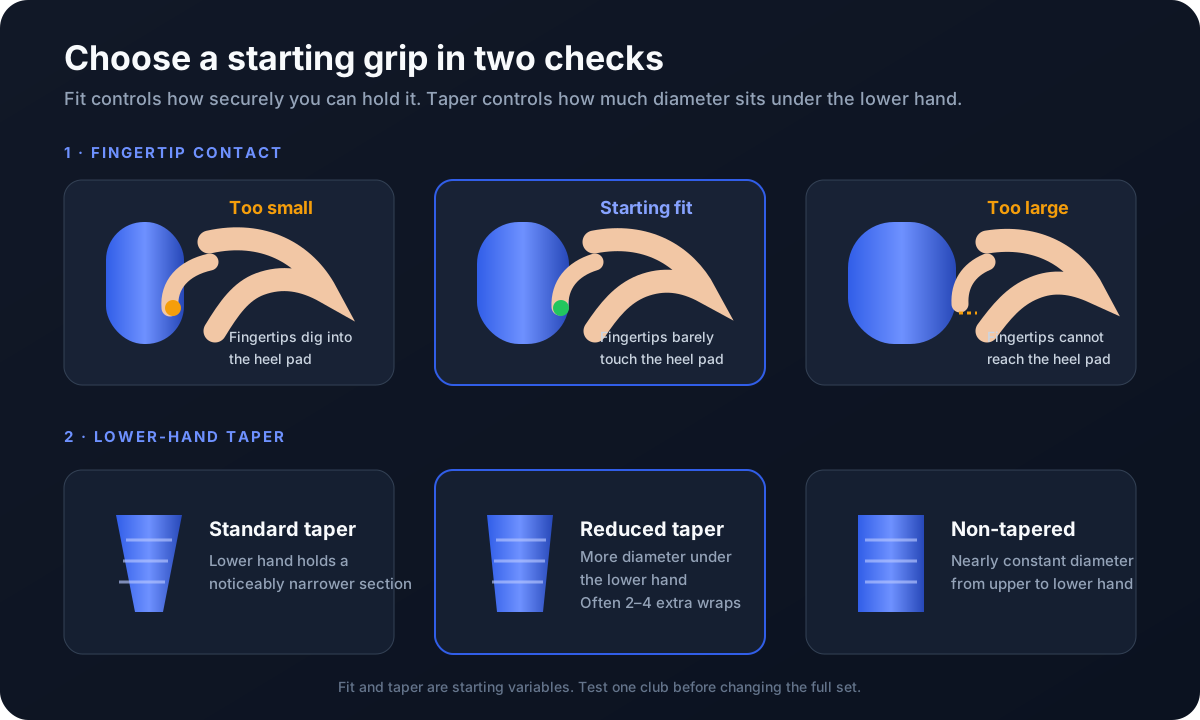
- Start with fit, then test one club — Hand or glove size gives you a starting category. On an installed grip, your lead-hand fingertips should barely touch the heel pad. If they dig in or cannot reach it, test another size before changing the full set.
- Taper changes the lower-hand feel — Traditional grips narrow toward the clubhead. Reduced-taper and non-tapered grips keep more diameter under the lower hand, which can make pressure feel more even. They do not guarantee a particular release or ball flight.
- Material choice is about conditions, not preference — Rubber grips offer the best all-around feel, cord grips dominate in wet and humid conditions, and polymer/synthetic grips provide maximum vibration dampening for golfers with joint pain. Pick based on where and how you play.
- Grip weight directly changes your swingweight — Every 5 grams of grip weight added reduces swingweight by approximately 1 point. Switching from a 50g standard grip to an 80g jumbo grip drops your swingweight by roughly 6 points — the equivalent of moving from D2 to about C6. That's a massive change that most golfers never account for.
- Replace grips by condition and use — Slick, hardened, cracked, or visibly worn grips are ready to go. A useful benchmark is an inspection at least yearly or around 40 rounds, adjusted for range time, climate, storage, and cleaning.
Why Your Grips Deserve More Attention Than Your Driver
Here's a question that should bother you: How much time did you spend picking your last driver? Hours of research, maybe a fitting, definitely some YouTube deep dives. Now, how much time did you spend choosing your grips?
If you're like most golfers, the answer is somewhere between "none" and "whatever the fitter put on." And that's a problem. Because your grips are the only physical connection between your body and the club. Every signal your brain sends to create a swing — every adjustment in pressure, every rotation of the hands through impact — passes through that 10.75 inches of rubber, cord, or polymer wrapped around the butt of the shaft.
Your driver head weighs about 200 grams and contacts the ball for roughly 0.5 milliseconds. Your grips weigh 50-80 grams each and you hold them for the entire swing. The grip shapes your pressure. The pressure shapes your tension. The tension shapes your swing. The math here is simple: the grip matters more than you've been giving it credit for.
This article covers the grip as a piece of equipment — size, taper, material, weight, and the downstream physics. We're not covering hand placement or grip style (strong, weak, neutral), and we're not covering putter grips. Those are their own conversations. This is about the rubber that sits on your shaft and everything it does to your game that you've probably never considered.
Grip Size: The Fundamentals
Golf grips are manufactured in four general size categories: undersize (also called junior or ladies), standard, midsize, and oversize (also called jumbo). The industry measures grip diameter at a point 2 inches below the butt cap when installed on a shaft, and the baseline is .900 inches for a standard grip.
| Size Category | Approx. Diameter (2" from cap) | Typical Offset from Standard | Typical Weight Range |
|---|---|---|---|
| Undersize / Junior | .840" – .870" | -1/32" to -1/16" | 38 – 48g |
| Standard | .900" | Baseline | 45 – 55g |
| Midsize | .940" – .960" | +1/32" to +1/16" | 50 – 67g |
| Oversize / Jumbo | 1.000" – 1.020"+ | +1/8" or more | 55 – 85g |
Here's what's important to understand: there is no universal industry standard beyond the .900" baseline for standard grips. "Midsize" from Golf Pride might be +1/16", but "midsize" from Karma Grips might be +1/32". Always check the manufacturer's specs rather than assuming all grips labeled the same size are actually the same diameter.
Core Size: .580 vs. .600
The core size refers to the inside diameter of the grip — the hole that slides over the shaft. The two standard core sizes are .580" and .600", which correspond to common shaft butt diameters. Here's the nuance most golfers miss:
A .580 core grip (often labeled M58) has the same outside diameter as a .600 core grip (M60) of the same model. The difference is in the wall thickness — the M58 has slightly thicker rubber walls to achieve the smaller inner diameter. When you install a .580 core grip onto a .600 butt diameter shaft, the grip stretches slightly, which makes the installed grip about 1/32" larger than if you'd used a .600 core on that same shaft.
Clubfitters use this to their advantage. Want a grip that's a hair bigger than standard but not quite midsize? Install a .580 core grip on a .600 shaft. It's a subtle trick, but it's one of the reasons custom fitting matters.
Core size (.580 vs .600) affects installed grip size but not the grip's labeled size. A .580 core on a .600 shaft plays slightly larger (+1/32"). A .600 core on a .580 shaft plays slightly smaller. Both are interchangeable and safe to install on either shaft size.
How Grip Size Affects Your Swing
The conventional starting point is simple: measure your lead hand or use your glove size, then pick the matching category. Golf Pride's fitting guide uses both measures and adds a useful installed-fit check: your fingertips should barely touch the heel pad. If they wrap into it, the grip is likely too small; if they cannot reach it, the grip is likely too large.[2]
The Grip Pressure Connection
That chart is a starting point, not a verdict. Two golfers with the same hand measurement can prefer different diameters because finger length, hand strength, joint comfort, texture, and the amount of pressure they naturally use all affect the result. Treat any exact distance or grip-pressure promise with caution: the useful test is whether you can hold the club securely without squeezing, keep your normal wrist motion, and return the face consistently.
Think about why this matters. When a grip is too small for you — whether because of your hand size, your strength, or just your natural tendencies — your fingers wrap too far around the grip and overlap or crowd. Your brain interprets this insecurity as "I might lose this club," and you squeeze harder. That squeeze creates tension in the forearms, which restricts wrist hinge, which reduces clubhead speed, which costs you distance.
Conversely, a grip that's too large fills your hands to the point where your fingers can't hinge properly. The wrists lock up (for a different reason), the club feels sluggish, and while you might hit it straighter, you lose both speed and feel.
The "Quiet Hands" Effect
A thicker grip can change how much hand and wrist action a golfer feels, but the common shorthand — larger grips stop hooks, smaller grips fix slices — is too neat. Grip diameter changes fit and leverage; it does not override swing path and face angle. Some golfers feel less lower-hand activity with a larger grip, while others simply feel less secure and squeeze harder.
If you are changing size to influence a hook or slice, change one club and measure the result rather than assuming the grip caused the ball flight. Grip size should first let you hold the club comfortably and repeatably. Directional changes are a possible fitting observation, not a guaranteed correction.
Here's a simple test: grip a club normally and look at your lead hand (left hand for right-handed golfers). If your fingertips are digging into your palm, the grip is likely too small. If there's a noticeable gap between your fingertips and the heel pad of your palm, it's likely too large. The sweet spot is when your fingertips just barely touch your palm — but don't confuse this with a final fitting. It's a starting point.
What Custom Builds Show Us
Custom builds reveal just how personal this decision is. Fitters can add full-length or lower-hand tape wraps to create a diameter and taper between retail sizes. Golf Pride's installation guidance says one extra wrap adds about 1/64 inch, two add 1/32, and four add roughly 1/16.[14]
The takeaway is not to copy a professional's build. It is that the four retail labels are broad categories, while tape lets a fitter tune the installed result. Your useful fit may sit between standard and midsize or may need extra diameter only under the lower hand.
Taper: The Variable Nobody Talks About
Every golf grip has a taper profile — the rate at which the diameter decreases from the butt end (where your top hand sits) to the tip end (where your bottom hand sits). Taper falls into three categories:
| Taper Type | Description | Best For | Potential Drawback |
|---|---|---|---|
| Standard Taper | Traditional profile; grip narrows noticeably from top to bottom hand | Golfers who want maximum wrist action and feel; players who prefer the security of a thinner lower section | Can encourage grip pressure imbalance between hands |
| Reduced Taper | Lower hand area is built up, simulating 2-4 extra wraps of tape | Golfers who tend to squeeze with the bottom hand; players seeking more even pressure distribution | May feel unusual if you've always played standard taper |
| Non-Tapered (Straight) | Consistent diameter from top to bottom | Golfers who fight excessive hand action; arthritis sufferers; players who over-grip | Can feel "blocky" and reduce feel for some players |
Why Taper Matters More Than You'd Expect
Traditional grips narrow toward the shaft tip, so the lower hand holds a smaller diameter. Reduced-taper designs build up that lower-hand section; a common factory version approximates several extra wraps of tape. The practical goal is a more substantial lower-hand feel and, for some golfers, more even pressure between the hands. That is a fitting preference rather than a universal biomechanical advantage.
A traditional taper can feel more secure or responsive to a golfer who likes the lower hand to sit in a narrower section. A reduced taper can feel calmer to a golfer who tends to squeeze with that hand. Neither profile guarantees quieter hands, a specific release, or a straighter shot. Test the pressure and face-control result.
Myth: "Tapered grips are the correct design because that's what the pros use."
Reality: Tape buildup can change the lower-hand diameter without changing grip models. Four extra wraps add roughly 1/16 inch, enough to create a meaningful fit change.[14] Reduced taper is an available fitting choice, not proof that every golfer should use it.
Tape Wraps and Custom Taper
The most common way to modify taper is through grip tape buildup. Each layer of tape wrapped around the shaft increases the diameter by approximately .007 inches. Four extra wraps of tape add roughly 1/16" to the diameter — enough to move from one size category to the next.
You can apply wraps selectively. Want a standard upper hand but a midsize lower hand? Add 4 wraps to just the lower section of the shaft before installing the grip. This is essentially what reduced-taper grips do from the factory, but tape gives you infinite customization.
One important distinction: building up with tape versus buying a larger grip produces different results. A larger grip has more rubber material, which gives a softer feel. Tape buildup stretches the existing rubber thinner, creating a firmer feel at the same diameter. Neither is objectively better, but they feel different in your hands.
If you find yourself re-gripping the club between shots or constantly fidgeting with the position of your lower hand, try a reduced-taper grip before changing anything else. It's a cheap experiment (a single grip costs $5-15) that addresses one of the most common comfort complaints in golf.
Grip Profiles: Round, Ribbed, and Alignment
Beyond size and taper, grips come in three internal profile options that affect how you orient the club in your hands.
Round Grips
A round grip is symmetrical — the same shape all the way around. There is no built-in reference point for hand placement, and the grip can be installed in any orientation. That can be useful on clubs whose face you deliberately open or close.
Ribbed (Reminder) Grips
Ribbed grips have a small ridge running along the back of the grip, created by a raised section on the inside of the grip that sits on the shaft. When properly installed, this ridge sits directly under the heel pad of your lead hand, providing a tactile reference for consistent hand placement. The ridge on traditional ribbed grips (like the Golf Pride Tour Velvet Ribbed) is subtle — you feel it, but you don't see it.
Alignment Grips
Alignment grips are the evolution of the ribbed concept, popularized by Golf Pride's ALIGN Technology starting around 2018. Instead of a hidden internal ridge, alignment grips feature an external raised ridge (often a different color) that you can both see and feel. The ridge is wider and more pronounced than a traditional rib, providing a stronger reference point.
The practical case for an alignment ridge is repeatability: it gives your hands a tactile reference in addition to the printed markings. That reference only helps if the grip is installed in the orientation you intend, especially on adjustable woods whose shaft setting may rotate.
Choose round when you want freedom to rotate the face or grip orientation. Choose ribbed or alignment when a repeatable hand reference helps. There is no rule that all 13 clubs need the same profile.
Materials: Rubber, Cord, Synthetic, and Hybrids
Grip material is where form meets function in a meaningful way. Your material choice should be driven primarily by playing conditions, secondarily by feel preference, and lastly by durability concerns.
Rubber
Rubber remains the most popular grip material and the default choice for good reason. Modern rubber grips use synthetic rubber compounds (not natural rubber) that provide a balanced combination of tackiness, durability, and shock absorption. They feel "alive" in the hands — responsive without being harsh.
Best for: Most golfers in most conditions. Dry to moderate climates. Players who prioritize feel and feedback.
Popular examples: Golf Pride Tour Velvet, Lamkin Crossline, Golf Pride CP2 Wrap.
Limitations: Performance degrades in sustained wet conditions. Rubber compounds can harden and lose tackiness over time, especially with UV exposure and temperature fluctuations.
Cord
Cord grips embed cotton string or woven fabric into the rubber compound, creating a rougher, more textured surface. This texture channels moisture away from your hands and maintains traction even when wet. Cord grips are the firmest option available and provide the most aggressive traction.
Best for: Golfers in humid or rainy climates, heavy sweaters, and players who want maximum traction and do not mind a firmer feel.
Popular examples: Golf Pride Z-Grip Cord, Lamkin Crossline Full Cord, Golf Pride Tour Velvet Cord.
Limitations: The rough texture can be abrasive on bare hands, especially during long practice sessions. Cord grips generally accelerate glove wear. Not ideal for golfers with sensitive hands or joint issues.
Polymer / Synthetic
Polymer grips use polyurethane-based or proprietary synthetic compounds that feel soft, tacky, and cushioned. They are designed to damp vibration and can feel more comfortable to golfers who dislike firm rubber or cord.
Best for: Golfers with arthritis, tendinitis, or hand pain. Players who prioritize comfort and vibration absorption. Cold-weather golfers (polymer stays softer in cold temperatures than rubber).
Popular examples: Winn Dri-Tac, Winn Excel, Karma Velour.
Limitations: Generally less durable than rubber or cord. The soft material wears faster and can become slick more quickly. Polymer grips also tend to be lighter, which affects swingweight (more on this below).
Hybrid (Multi-Compound)
Hybrid grips combine two or more materials in different zones. The most common configuration pairs cord in the upper hand area for traction and moisture management with rubber in the lower hand area for a less abrasive feel.
Best for: Golfers who want wet-weather performance without committing to full cord. Players who want traction in the lead hand and feel in the trail hand.
Popular examples: Golf Pride MCC, Golf Pride MCC Plus4 (reduced taper + hybrid material), Lamkin Z5 Multi-Compound.
| Material | Tackiness | Wet Performance | Vibration Dampening | Durability | Typical Weight |
|---|---|---|---|---|---|
| Rubber | High (when new) | Moderate | Moderate | Good | 48 – 55g |
| Cord | Moderate (texture-driven) | Excellent | Low | Excellent | 50 – 62g |
| Polymer | Very High | Good | Excellent | Fair | 36 – 50g |
| Hybrid | High (varies by zone) | Very Good | Moderate | Good | 48 – 58g |
Myth: "Cord grips are only for low-handicap players and pros."
Reality: Cord grips are for anyone who plays in humid or wet conditions, period. A 20-handicap in Houston will benefit more from cord grips than a scratch player in Phoenix. Match the material to your environment, not your ego.
Grip Weight, Swingweight, and Moment of Inertia: The Physics You're Ignoring
This is the section most golfers skip and most articles gloss over. Don't. Grip weight has real, measurable effects on how your club feels and performs — and understanding the physics helps you make smarter decisions.
The Swingweight Connection
Swingweight is a measurement of how heavy a club feels during the swing, expressed on a scale from A0 (very light) to G10 (very heavy). Most men's clubs are built to D0-D2; most women's clubs to C5-C7. The measurement is taken on a swingweight scale with a fulcrum point 14 inches from the butt end of the club.
Here's the critical relationship: for every 5 grams added to the grip end, swingweight decreases by approximately 1 point. For every 5 grams removed, swingweight increases by approximately 1 point.
Let's run through a real scenario:
| Scenario | Grip Weight | Weight Change | Swingweight Change | Starting D2 Becomes... |
|---|---|---|---|---|
| Standard rubber grip | 50g | Baseline | Baseline | D2 |
| Midsize rubber grip | 60g | +10g | −2 points | D0 |
| Midsize cord grip | 65g | +15g | −3 points | C9 |
| Jumbo rubber grip | 75g | +25g | −5 points | C7 |
| Jumbo cord grip | 82g | +32g | −6 points | C6 |
| Lightweight polymer grip | 38g | −12g | +2 points | D4 |
Look at the spread. A golfer switching from a lightweight Winn polymer grip (38g) to a heavy jumbo cord grip (82g) is looking at a 44-gram difference, which translates to roughly an 8-9 swingweight point shift. That's the difference between a club that feels like a feather and one that feels like a sledgehammer. Most golfers would notice a 2-point swingweight change. An 8-point change would be disorienting.
Modern grip engineering has partially decoupled grip size from grip weight. Companies like JumboMax and Winn now produce jumbo-diameter grips in the 50-60g range — close to a standard grip's weight. If you want a larger grip without the swingweight penalty, lightweight oversize grips exist. But you need to check the spec sheet, not assume.
The Moment of Inertia Wrinkle
Here's where the physics gets interesting and slightly counterintuitive. While grip weight has a large effect on swingweight (which is a static measurement), it has a relatively small effect on the club's moment of inertia (MOI), which is the dynamic measurement of how much force it takes to rotate the club around its swing axis.
Why? Because the grip end of the club is close to the axis of rotation (your hands). Adding mass near the axis doesn't change the rotational resistance nearly as much as adding the same mass far from the axis (at the clubhead). This is basic rotational physics — MOI depends on mass and the square of the distance from the axis.
In practical terms: if you add 30 grams to the grip, the swingweight scale says the club is dramatically different, but the actual feel during the swing changes far less than the scale suggests. The club does feel slightly different — total weight increases, and the balance point shifts toward your hands — but the dynamic resistance during the swing barely changes.
This matters because some golfers panic when they see their swingweight drop after installing heavier grips. The number on the scale has moved, yes. But the sensation during the swing isn't as different as that number implies. Some clubmakers now advocate matching clubs by MOI rather than swingweight for exactly this reason.
If you switch to a grip that's 15-20g heavier and the swingweight drops 3-4 points, don't panic. Hit balls first. You may not notice a meaningful difference in how the club swings. If you do feel the club is too light in the head, a simple fix is adding 2-4 grams of lead tape to the clubhead to bring the swingweight back. Many fitters do this routinely when re-gripping to heavier grips.
Counterbalancing: Using Grip Weight on Purpose
Some golfers and fitters intentionally use grip weight to change how a club feels. Adding weight to the grip end (through heavier grips, weighted grip caps, or lead tape under the grip) is called "counterbalancing." It increases total club weight while making the head feel lighter.
Counterbalancing can help golfers who:
- Struggle with tempo and tend to cast or release early (lighter head feel encourages patience)
- Want more total weight for stability without the head feeling heavy
- Use very lightweight shafts and want to add mass without changing shaft flex characteristics
This is an advanced fitting concept, but it's one more reason to think about grip weight as a tuning tool rather than just an afterthought.
Grip Replacement: When, Why, and What It Costs You
Grip performance degrades gradually. Unlike a torn glove or a scuffed ball, a grip can become glossy, hard, or less tacky while still looking usable at a glance. Your hands may compensate by squeezing harder before you consciously notice the change.
Worn grips lose texture and tack, which can make you squeeze harder or let the club move in your hands. There is no credible universal conversion from grip age to strokes lost: the effect depends on the golfer, conditions, material, and amount of wear. The defensible conclusion is simpler—when cleaning no longer restores traction, the grip is no longer doing its job.
When to Replace
Golf Pride recommends regripping at least once a year, adjusted for how often you play or practise, and elsewhere gives roughly 40 rounds as a performance benchmark.[10] Treat those numbers as inspection reminders rather than expiry dates. Range sessions, sweat, rain, heat, storage, and cleaning can shorten or extend useful life.
For less frequent players (once a week or less), annual replacement is still recommended because grips deteriorate from age, UV exposure, heat, humidity, and oils from your hands even when they're sitting in the garage.
Signs Your Grips Need Replacing
- Visual: Shiny or glossy patches, especially where your thumbs and fingers sit
- Tactile: The grip feels smooth or slick where it used to feel textured
- Structural: Cracks, splits, hardening, or the grip has visibly worn thin in spots
- Behavioral: You're gripping harder than you used to. You're adjusting your hands more between shots. Your gloves are wearing out faster (you're compensating for grip traction with grip pressure)
Myth: "Grips are fine until they start falling apart."
Reality: By the time a grip shows visible wear, it's been underperforming for months. Traction loss is gradual and invisible. If you can't remember when you last re-gripped, you're overdue. Think of grips like tires — you don't wait until the steel belts show.
Grips and Health: Arthritis, Joint Pain, and Injury Prevention
This section matters more than most golfers realize, especially as the average golfer ages. Using grips that are wrong for your hands doesn't just affect your scores — it can cause or worsen physical problems.
The Arthritis Case
Oversized grips are widely recommended by hand therapists and golf professionals for golfers with arthritis. The principle is straightforward: when you hold something larger, you don't need to squeeze as hard to maintain control. This reduces stress on the metacarpophalangeal (MCP) and interphalangeal (IP) joints — the exact joints most affected by osteoarthritis and rheumatoid arthritis.
An exploratory university project described testing 40 participants, half with arthritis, across multiple grip designs using strain gauges.[15] That work is useful context, but it is not enough to prescribe one grip as treatment. Manufacturer fitting guidance suggests sizing up, while still ensuring secure control, and considering a softer grip for comfort.[2]
Beyond size, material matters for joint health. Polymer grips (like the Winn Dri-Tac or Lamkin Arthritic) absorb significantly more vibration at impact than rubber or cord grips. For golfers with sensitive joints, that vibration dampening isn't a luxury — it's the difference between playing 18 holes and stopping at 12.
Golfer's Elbow and Grip Pressure
Medial epicondylitis (golfer's elbow) is directly linked to excessive grip pressure and forearm tension. While the root cause is usually swing mechanics, incorrectly sized grips exacerbate the problem. A grip that's too small forces the forearm flexors to work harder, increasing strain on the medial epicondyle. Moving to a properly fitted grip — often a size up from what the "hand chart" suggests — can meaningfully reduce symptoms.
If hand, wrist, or elbow pain persists, changes, or affects daily activity, talk with a qualified clinician. As part of an equipment conversation, you can also ask a fitter about testing one club with a larger, softer grip. A more comfortable test does not diagnose the cause of pain, and it should not replace medical care.
The Market Leaders: What's Available in 2026
The golf grip market is dominated by three major players, with several strong niche competitors.
Golf Pride
Golf Pride offers one of the broadest current ranges of rubber, cord, hybrid, reduced-taper, and alignment grips. Its published specifications are especially useful when you need to compare size, core, and weight rather than shop by model name alone.[2]
Best known for: Tour Velvet (standard rubber), MCC (hybrid), Z-Grip (full cord), CP2 (comfort/wrap), ALIGN variants of everything.
Lamkin
Lamkin covers the same major fit categories with rubber, cord, hybrid, softer comfort models, and Calibrate alignment ridges. Crossline and UTX sit at the firmer, more textured end of the range; its comfort models move the other direction.
Best known for: Crossline (classic cord), UTX (full cord), Z5 (multi-compound), Arthritic (oversized comfort).
Winn
Winn owns the polymer/synthetic segment. Their Dri-Tac is the go-to recommendation for golfers who prioritize softness, tackiness, and vibration dampening. The Dri-Tac 2.0 improved durability, which was historically the Winn weakness.
Best known for: Dri-Tac (polymer standard), Excel (soft), Lite (ultralight).
Other Players Worth Knowing
- SuperStroke — Known for putter grips but expanding into swing grips with the S-Tech (reduced taper, lightweight).
- JumboMax — Specializes in oversized grips with lightweight construction. Their jumbo grips weigh close to standard grips, solving the swingweight problem.
- Karma — Value-oriented brand with solid offerings. Their Velour grip is a budget-friendly Tour Velvet alternative.
- Iomic — Japanese brand using a proprietary elastomer material. Popular in Asia and gaining traction in the US.
A Decision Framework: Choosing Your Grips
Here's how to think through the decision systematically, rather than just grabbing whatever's on sale at the pro shop.
Step 1: Start with Conditions
Where do you play most often? If it's a humid or wet climate, cord or hybrid should be your baseline. If it's dry, rubber or polymer gives you more feel options.
Step 2: Address Any Physical Issues
Hand pain, arthritis, golfer's elbow, or grip fatigue? Move toward softer materials (polymer) and consider going up one size. These aren't vanity choices — they're functional ones.
Step 3: Evaluate Your Tendencies
Do you fight a hook? A larger grip or reduced taper might help quiet your hands. Slice? Be careful with oversized grips that might restrict the hand action you need. Over-grip the club? A larger diameter naturally reduces the urge to squeeze.
Step 4: Mind the Weight
Check the spec sheet. Know what your current grips weigh and what the new ones weigh. If the difference is more than 10 grams, be aware of the swingweight shift and decide whether you need to compensate with head weight.
Step 5: Try Before You Commit
Re-grip one club first. Live with it for a week or two. Your hands will tell you if it's right before your scores do.
The best grip in the world is the one you don't think about. If you're aware of the grip in your hands during your swing, something is wrong — too small, too large, too slick, too hard. The right grip disappears. It becomes part of your hands, not something your hands are holding. That's the goal.
Final Thought
Golfers will spend heavily on a driver and rarely question the grip that connects them to it. They'll get fitted for shaft flex and lie angle but install whatever grip the shop has in stock. A worn or poorly fitted grip can add tension and reduce traction even when the head and shaft fit correctly.
Your grips are equipment. They have specifications, they have performance characteristics, and they wear out. Treat them like the critical component they are: choose them deliberately, fit them to your hands and your game, check their weight against your swingweight, and replace them before they cost you shots you'll never know you lost.
Regripping is a relatively inexpensive fitting experiment. Change one club, compare it in the conditions you actually play, and let comfort, control, and measured ball flight decide.
Sources & References
- Mucklow, L. PGA. Grip size fitting research on grip pressure and carry distance. Tour Quality Golf
- Golf Pride. Grip Specifications — Swing Grip Size Guide. Golf Pride Grip Academy
- Hireko Golf. "5 Factors That Influence Golf Grip Sizing Explained." Hireko Golf
- Hireko Golf. "Golf Grip Materials Explained: Rubber vs Polymer vs Cord vs Hybrid." Hireko Golf Blog
- Hireko Golf. "Weight & Weight Distribution in Club Fitting Explained." Hireko Golf
- Hireko Golf. "Is Non-Tapered or Reduced Taper Golf Grip Right For You?" Hireko Golf
- Mitchell Golf. "A Guide for Grip Measuring & Sizing." Mitchell Golf
- Golf.com. "3 Things We Learned From Analyzing Tour Grips." Golf.com Bag Spy
- Golf.com. "What grips do the world's best golfers use?" Golf.com
- Golf Pride. "Grip Wear — When to Replace Your Grips." Golf Pride Grip Academy
- SuperStroke. "When to Replace Golf Grips and Other Regripping FAQs." SuperStroke Blog
- Grips4Less. "Difference Between Ribbed and Align (Alignment) Grips." Grips4Less
- Lamkin Grips. "Round vs. Reminder: What's in Your Core?" Lamkin Grips
- Golf Pride. "Golf Grip Tape Build Up: How To." Golf Pride Blog
- Medical Xpress. "Golf-grip study may reduce pain, improve play for those with arthritis." Medical Xpress
- JumboMax. "Grip Weight — Lightweight Oversize Grips." JumboMax
- Chris Cote's Golf Shop. "How Thicker Golf Grips Can Help with Arthritis." Chris Cote's Golf
- Tutelman, D. "Design Notes: Heft — Swingweight and MOI." Tutelman.com
- MyGolfSpy. "Golf Grip Size Chart: What Size Do You Need?" MyGolfSpy
- Golf Digest. "Why Grip Size Is Way More Important Than You Think." Golf Digest