Boiled goose feathers, a statue of a Hindu god, a pile of rubber bands, and a 6-iron on the lunar surface — the little ball in your pocket has the strangest backstory in sports. Here's the whole tale, myths busted and all.

- The golf ball has lived four lives — the leather-and-feather featherie (1600s–1850s), the rubbery guttie (1848), the rubber-wound Haskell (1899), and the modern solid-core ball (1960s–today). Each one didn't just change distance; it changed who could afford to play.
- Dimples were a happy accident. For centuries the ball was smooth. Golfers noticed that scuffed balls flew straighter and farther, started beating up new balls on purpose, and only decades later did anyone patent a proper dimple pattern (William Taylor, 1905).
- The featherie was a luxury good, not a humble relic. A top one cost about a crown (five shillings) — frequently more than a golf club — and a skilled maker finished only three or four a day. Its expense kept golf an elite game for two centuries.
- The Pro V1 was not the first solid-core ball — Mark O'Meara won two majors in 1998 on a Strata, and Tiger won the 2000 U.S. Open by 15 on a Nike. The Pro V1 was simply the one that made the whole tour switch at once.
- The next chapter is being written right now. After years of debate, golf's rulemakers set out to roll the ball back — then, in June 2026, paused the whole plan. Nothing changes before January 2030 at the earliest, and the governing bodies have admitted the proposal may not have been enough.
Why a Ball Is the Most Interesting Thing in Your Bag
We obsess over drivers and putters, but the golf ball is the only piece of equipment that touches every single shot. It's also, quietly, the most consequential. Every time the ball got better, golf itself changed — how far courses had to stretch, how much a round cost, and who was allowed through the gate to play in the first place.
And the story of how we got from a sack of wet feathers to a precision-engineered, multi-layer sphere is genuinely wild. It involves a divinity student, a statue of a Hindu god, a pile of rubber bands in an Ohio factory, a 1902 Open champion who borrowed the idea from a friend, and an astronaut sneaking a clubhead onto a spacecraft. Let's walk through it, era by era — and bust a few myths that golf has been repeating for 200 years.
Every leap in golf ball history was really about one of two things: flight (how far and how straight it goes) or access (how many people can afford to play). The best inventions delivered both at once. Keep that lens and the whole 600-year arc makes sense.
Act I: The Wooden Ball — The Myth We Should Stop Repeating
Open almost any golf history and you'll read that the earliest golfers played with hardwood balls carved from beech or boxwood. It's a tidy origin story. It's also… not actually proven.
The leading scholarly source on the subject, Scottish Golf History, puts it bluntly: the use of wooden balls in Scottish golf "is an assumption, but without any definite evidence." No Scottish wooden golf balls survive. No written account from the period describes them. The idea is borrowed from related continental stick-and-ball games like the Dutch colf and French jeu de mail, where wooden balls genuinely were used — and where they flew a clumsy 75 meters or so and were nearly impossible to control.
What is documented is the ball that came before the featherie: the leather "hairy" ball — stitched cowhide stuffed with cow's hair — imported from the Netherlands and made in Scotland from 1554. The oldest surviving leather ball, found in Stirling Castle, dates to around 1514.
Myth: "The first golfers used wooden balls." Reality: There's no hard evidence Scottish golfers ever did. Wooden balls belong to related European games. The first documented golf ball in Scotland was the leather, hair-stuffed "hairy" ball — the featherie's scruffy older cousin.
Act II: The Featherie — A Luxury Sphere of Boiled Feathers
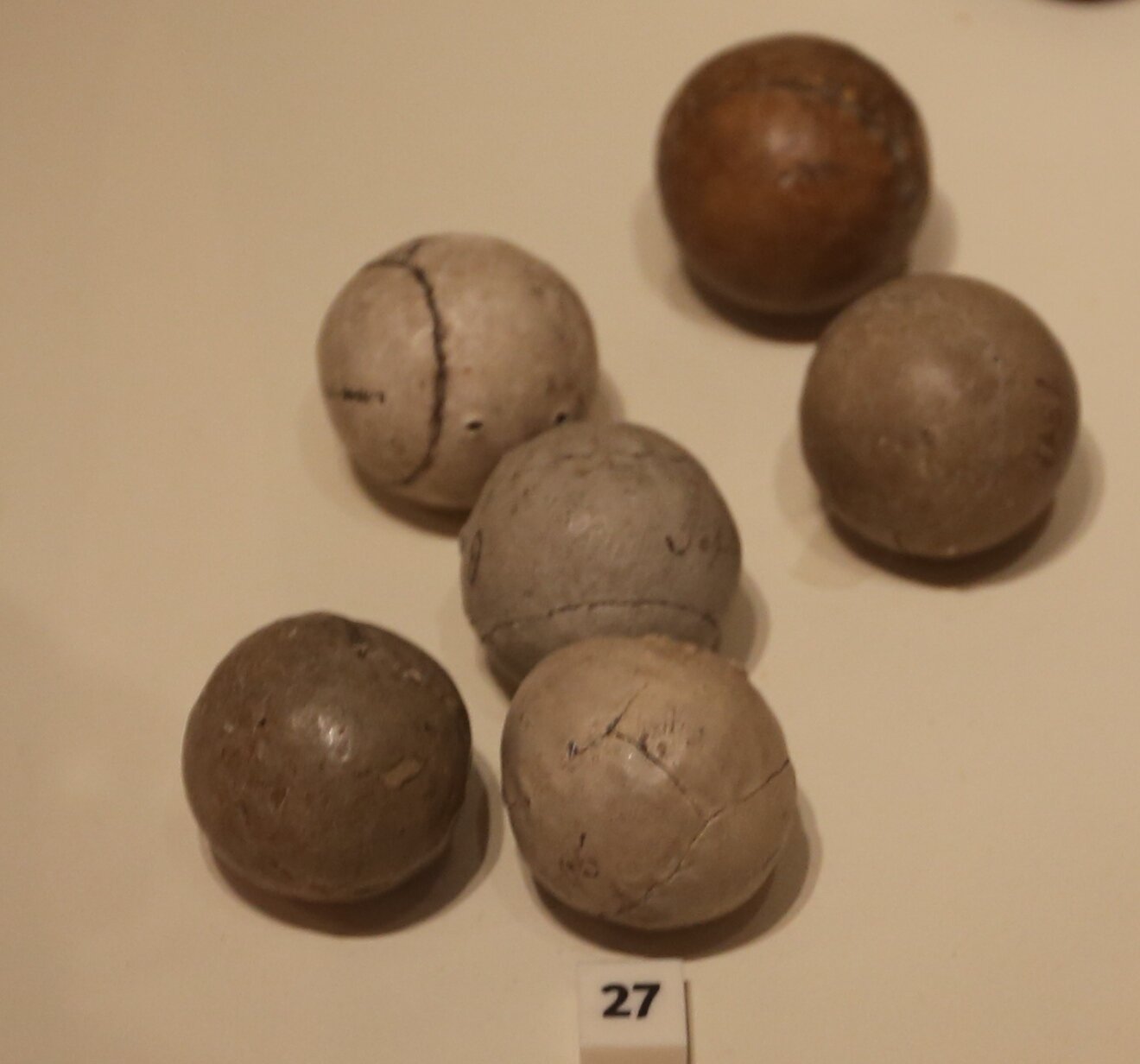
For more than two centuries, from the early 1600s to the 1850s, the king of golf balls was the featherie: a hand-sewn leather pouch crammed with feathers. By tradition it appeared around 1618, though a 1612 Edinburgh estate inventory already lists 112 "flok goiff ballis," so "early 1600s" is the honest dating.
How you actually made one
The process sounds like a folk recipe, because it basically was. A maker stitched three pieces of leather (cowhide or horsehide) together, turned the pouch inside out to hide the seams, and left a small slit. Then came the feathers — famously, "a top hat full" of boiled goose feathers, softened and compressed and forced into the pouch through the slit with a brogue, a stuffing iron pressed against the chest for leverage. The slit was sewn shut, and here's the clever part: both the leather and the feathers went in wet. As the ball dried, the leather shrank while the feathers expanded, the two forces meeting in the middle to create a surprisingly hard, compact sphere. A few coats of paint, and you had a golf ball.

Why it kept golf a rich man's game
A skilled craftsman did well to finish three or four featheries in a day. That scarcity made them expensive: a top-quality ball cost around a crown — five shillings — which was frequently more than the price of a club. Lose a couple in the gorse and you'd spent a small fortune. The leather also split when wet, so a sodden round could be ruinous.
This is the single most under-told fact about early golf: the ball, not the clubs, was the luxury item, and its cost is a big reason the game stayed locked to the wealthy for 200 years. The best makers became famous — Andrew Dickson of Leith and Henry Mill of St Andrews are among the earliest named, and Allan Robertson, widely called golf's first professional, ran a featherie workshop so productive it turned out a documented 2,456 balls in 1844 alone.
Myth: "Old golf balls were cheap, primitive things." Reality: The featherie was a premium, labor-intensive luxury good — often pricier than a club, and a status object in its own right. The "cheap golf ball" wouldn't arrive until 1848.
The 361-yard drive (with a giant asterisk)
You'll hear that the featherie could be crushed enormous distances — the legendary figure is a 361-yard drive by Samuel Messieux at St Andrews in 1836. It's a great story, but it was a one-off: downwind, over frozen, icy ground that let the ball run forever. A normal good drive with a featherie was more like 180 to 200 yards. Impressive for a bag of feathers, but the record belongs in the "reportedly" file.
Act III: The Guttie — How a Statue's Packing Material Democratized Golf
In 1848, everything changed, and the catalyst — by the most-repeated version of the story — was a statue. A St Andrews divinity student named Rev. Robert Adams Paterson is said to have received a religious statue (often described as a Hindu god, Vishnu) shipped from the Far East, packed for protection in a strange rubbery substance called gutta-percha. He molded the leftover packing material into a ball, and the guttie was born.
It's a charming tale, and worth telling — but be honest that it's contested. As early as 1896, golf historian Rev. John Kerr named at least three other candidates for the invention. Paterson is the figure popular history settled on, not the undisputed sole inventor.
Gutta-percha itself is the dried sap of the Palaquium gutta tree from the Malay Peninsula — a natural thermoplastic. Heat it in boiling water and it goes soft and moldable; let it cool and it holds its shape like rock. That single property was revolutionary, and not only because it was cheap: a guttie that went out of round could be tossed back in the hot water and re-formed, something no featherie could ever do.
The real reason it took over: price
A featherie cost about five shillings. A guttie cost about one. Roughly a quarter of the price, with none of the fragility — and you could mass-produce them in iron molds. For the first time, a working person could afford to play. Golf's explosive spread in the second half of the 1800s rides almost entirely on this little gray ball.

Myth: "The guttie won because it flew farther." Reality: A brand-new, perfectly smooth guttie actually flew shorter than a good featherie. It won on price and durability. The distance — ironically — only came once golfers learned to rough the surface up. Which brings us to the single most important accident in golf history…
The Happiest Accident in Golf: The Birth of the Dimple
Early gutties had a maddening quirk. A brand-new, glassy-smooth one would duck and wobble through the air. But an old, beaten-up guttie — one that had been nicked and scuffed by iron clubs over a few rounds — flew higher, straighter, and farther. Players noticed. And then they did the logical thing: they started deliberately hammering patterns into their new balls to make them fly like old ones.
At first this was done by hand, around 1855 to 1875, with a chisel-headed hammer tapping a grid of nicks across the surface. Then it was standardized in the molds themselves — Willie Dunn cut a patterned iron mold at Musselburgh in 1871 — and the dominant look became the bramble: a surface of raised, berry-like bumps.
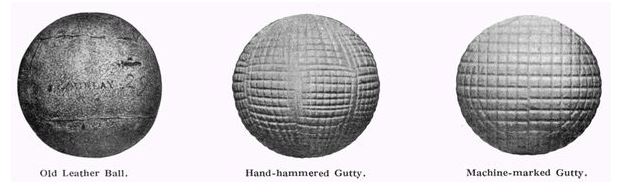

Here's the beautiful part: golfers had stumbled onto real aerodynamics by pure trial and error. A perfectly smooth sphere is actually bad at flying — the air flowing around it separates early and leaves a big, draggy, low-pressure wake behind it. A textured surface "trips" the thin layer of air clinging to the ball into turbulence, which (counterintuitively) clings to the ball longer, shrinks that draggy wake, and cuts pressure drag dramatically. Add the backspin a lofted club imparts, and the texture helps generate lift, too. A dimpled ball can fly roughly twice as far as a smooth one — some experiments suggest even more.
The recessed dimple we know today was patented by English engineer William Taylor in 1905, after he systematically tested surface formations (he'd noticed the same scuffed-ball effect). Recessed dimples beat raised brambles, and by around 1908 the dimple had taken over. The patterns kept evolving — smooth, then bramble, then a mesh/lattice grid (Dunlop popularized one around 1912), then dimples — but the principle has never changed.
Myth: "Dimples just reduce drag." Reality: It's more elegant than that. Dimples cut pressure drag (the big one) by about half and they increase lift — while very slightly increasing friction drag. The net effect is a ball that flies far higher and longer. And no, golf balls weren't always dimpled. They were smooth for centuries.
Act IV: The Haskell — "Bounding Billy" and the Rubber Revolution
The next leap came from America, and from rubber. In 1898, a Cleveland golfer named Coburn Haskell, waiting for a friend at the B.F. Goodrich plant in Akron, Ohio, started winding a long rubber thread into a ball and bouncing it — it shot toward the ceiling. With Goodrich's Bertram Work, who engineered a machine to wind the rubber thread under high, even tension, Haskell created the rubber-wound ball: a solid rubber core, wrapped in tightly wound elastic thread, wrapped in a gutta-percha (later balata) cover. The patent was granted on April 11, 1899.
(One myth to retire here: it was B.F. Goodrich, not Goodyear. The two Akron rubber giants get mixed up constantly.)
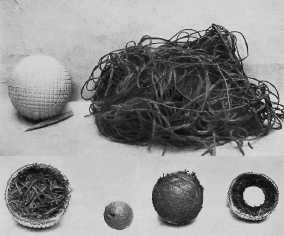

The Haskell flew about 20 to 25 yards farther than a guttie — "about two clubs" — and it had a lively, springy bounce that earned it a perfect nickname: "Bounding Billy." But golfers, being golfers, were skeptical of the newfangled thing.
The 1902 Open that ended the argument
The turning point was Hoylake, 1902. Alexander "Sandy" Herd was a doubter until he played a practice round with the Haskell at the urging of an amateur, John Ball. He switched for the championship — and won The Open, becoming the first Champion Golfer to lift the Claret Jug with a rubber-wound ball, after Harry Vardon and James Braid both missed putts on the closing holes to catch him. When the best players in the world saw that, the guttie's days were over within a couple of seasons.
The wound ball would go on to rule for nearly a century. As late as the 2000 U.S. Open, roughly 70% of the field still played wound balls. Think about that: from 1902 to 2000, the fundamental architecture of the elite golf ball barely changed.

Getting the Rules Right: The Great Ball-Size War
Once the ball could fly, somebody had to write rules so it didn't fly too well — and so everyone played roughly the same thing. This turned into one of golf's longest-running feuds: the great trans-Atlantic ball-size war.
The two governing bodies — the USGA (founded 1894) and The R&A in St Andrews — couldn't agree on how big the ball should be. The USGA adopted the larger "American ball" — minimum 1.68 inches in diameter, maximum 1.62 ounces in weight — announced in 1931 and effective January 1, 1932. The R&A stuck with the smaller "British ball," with a minimum diameter of just 1.62 inches. The smaller ball bored through wind better and flew a touch farther, so for decades even American pros switched to the small ball when they played in Britain.
The standoff lasted an astonishingly long time. The R&A finally required the larger 1.68-inch ball at The Open in 1974 — and only made it universal on January 1, 1990. That date, not 1932, is the real death of the small ball.
| Era | Ball | Key spec / change | What it changed |
|---|---|---|---|
| to ~1600s | "Hairy" leather ball | Leather stuffed with cow's hair (from 1554) | First documented golf ball in Scotland |
| ~1618–1850s | Featherie | Boiled feathers in stitched leather; ~5 shillings | Kept golf an elite game for 200 years |
| 1848–1900 | Guttie | Molded gutta-percha; ~1 shilling | Made golf affordable; brought the dimple |
| 1899–~2000 | Haskell (wound) | Rubber core + wound thread; +20–25 yds | Added serious distance; ruled for a century |
| 1968–1990s | Two-piece Surlyn | Solid core + cut-proof ionomer cover | Durable, cheap distance for amateurs |
| 2000–today | Multi-layer urethane (Pro V1 era) | Solid core + cast urethane cover | Distance and spin; ended the wound era |
Today the rules are harmonized worldwide. A conforming ball weighs no more than 1.620 ounces (45.93 g), measures at least 1.680 inches (42.67 mm) in diameter, can't exceed an initial velocity limit (a standard adopted back in 1942), and must stay within the Overall Distance Standard — capped at 317 yards under the test conditions, not the ~280 figure you'll sometimes see quoted.
Act V: Going Solid — Surlyn, the Two-Piece Ball, and the Weekend Golfer
For most of the 20th century there was a painful trade-off. The wound balata ball the pros loved spun beautifully and felt soft — but it cut open on a single thin iron shot, and it was expensive. The average golfer wanted something that lasted.
The answer came from chemistry. In the 1960s DuPont introduced Surlyn, a tough ionomer resin. Spalding launched its first two-piece ball — a solid core under a durable cover — in 1968, and by around 1972 the Surlyn-covered version carried the name that became legend: Top-Flite. (A small accuracy note: the famous 1968 ball actually launched with a urethane cover; the Surlyn-and-Top-Flite combination came a few years later. The two events get blurred together constantly.)
The two-piece Surlyn ball was nearly impossible to cut, flew far and straight, and cost a fraction of a balata. For millions of recreational golfers it was the perfect ball. The only thing it gave up was the soft feel and greenside spin the pros couldn't live without — which set up the problem the next ball would finally solve.
There's a lesson buried in the Surlyn era that still holds: the "best" ball and the "right" ball aren't always the same. Tour pros needed spin and feel; weekend golfers needed durability and value. Both were making the correct choice for their game. The history of the golf ball is, in a way, one long argument for picking equipment based on who you actually are — not on what the best player in the world happens to use.
Act VI: The Pro V1 — The Ball That Made Everyone Switch at Once
In October 2000, at a PGA Tour event in Las Vegas, Titleist put out the Pro V1: a large solid core, an inner casing, and a cast urethane cover with 392 dimples. It promised the impossible — the distance of a solid two-piece ball and the soft feel and spin of a wound balata. Billy Andrade won that very week, and an astonishing 47 players switched to the new ball in its first event. Titleist still calls it the largest single-event equipment shift in golf history. Within months the wound ball — a century-old design — was essentially dead.
Myth: "The Pro V1 was the first solid-core, urethane-covered ball." Reality: Not even close. Mark O'Meara won both the 1998 Masters and Open Championship using a solid-core Strata ball, and Tiger Woods won the 2000 U.S. Open by 15 shots on the solid-core Nike Tour Accuracy — months before the Pro V1 launched. The Pro V1 didn't invent the category. It won the category, by getting the entire tour to switch at once.
That modern multi-layer design — a solid core (or several layers of core), a mantle or two, and a thin urethane cover — is the ball you play today. Engineers can now tune each layer independently: a soft, fast core for distance and a grippy cover for greenside spin. It's the most sophisticated the ball has ever been.
Act VII: The Rollback — Golf Decides the Ball Got Too Good
Which brings us to the strangest twist of all: for the first time in 600 years, golf's rulemakers have decided the ball is flying too far — and they're winding it back.
After the joint USGA/R&A Distance Insights Report in 2020 concluded that ever-increasing distance is bad for the game (longer courses, more water, more land, more cost), the governing bodies announced in December 2023 that they'd tighten the ball's testing conditions — essentially testing it at a higher swing speed (raising the test from 120 to 125 mph) so that the hottest balls have to be dialed back to conform.
The timeline has shifted twice, and this is the part a lot of articles still get wrong. The original plan split the change into two dates (2028 for elite play, 2030 for everyone else). Then, in a joint statement on June 17, 2026, the USGA, R&A, PGA Tour, and DP World Tour scrapped the split — and went further, pausing the rollback entirely. Nothing changes to the ball's testing standard before January 2030 at the earliest, and the governing bodies are now reassessing the whole approach.
The reason for the pause is remarkable candor: the fix might not have been big enough. USGA CEO Mike Whan called the ball change "a small, digestible bite that the industry can handle" and conceded it "probably isn't enough." Cameron Young had already reported testing a ball built to the proposed spec without losing meaningful distance — then hit a 375-yard drive at the 2026 Players Championship. Whatever eventually lands in 2030 will likely involve more than the ball, possibly including driver head shape or face thickness.
How much distance would it actually have cost? Less than the panic suggests. The governing bodies' own estimates put the loss at roughly 9 to 11 yards for the average elite man (13 to 15 for the very longest), around 5 to 7 for elite women, and about 5 yards or less for recreational golfers — which one USGA official memorably called a "nothingburger" for the average player. More than 30% of currently conforming balls would still have conformed.
We went deep on the full rules story — the flagstick, the 14-club limit, anchoring, grooves, and where the rollback stands now — in golf's biggest rule changes.
The rollback is the first time golf has tried to run the ball's story in reverse. For six centuries every change made the ball go farther. That the rulemakers are now trying to give distance back — and finding it genuinely hard to do — is a sign of just how completely the modern ball conquered the problem of flight.
Bonus Round: Golf Ball Trivia Worth Knowing
The two balls on the Moon
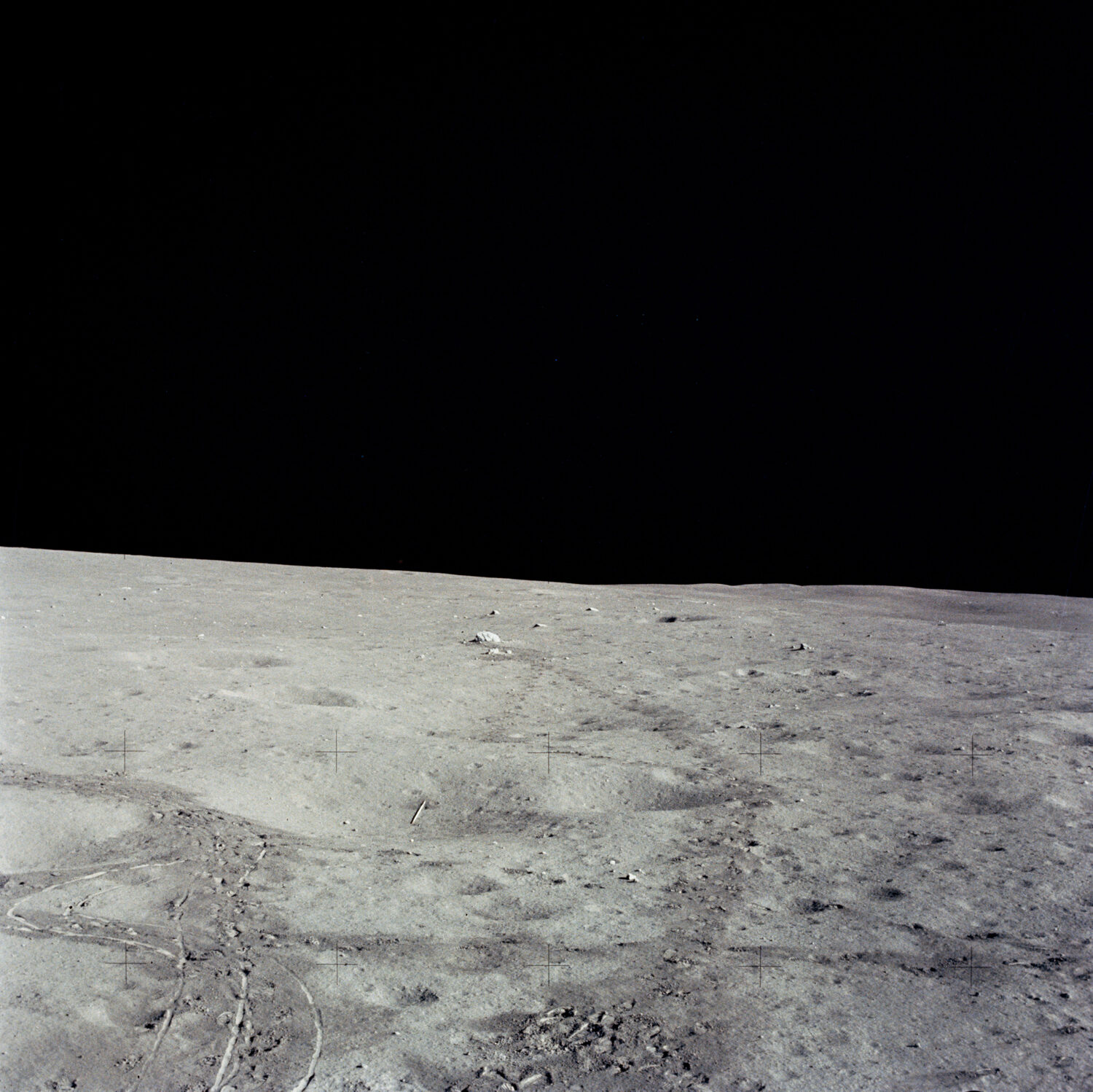
On February 6, 1971, Apollo 14 commander Alan Shepard smuggled a Wilson 6-iron head onto the mission, attached it to a lunar-sample tool handle, and — swinging essentially one-handed in a stiff pressurized suit — hit two golf balls on the Moon. He joked the second went "miles and miles and miles."
_on_Febr(...)_-_NARA_-_16697764.jpg)
"Miles" it was not. In 2021, using NASA's high-resolution lunar imagery, imaging specialist Andy Saunders located the balls and calculated the real distances: roughly 24 yards and 40 yards. Still — not bad, one-handed, in a spacesuit, on the Moon.
The $194,000 golf ball
The most expensive golf ball ever sold is a gutta-percha "Vardon Flyer" that Harry Vardon used to win the 1900 U.S. Open. It fetched $194,259.20 at auction in June 2025 — engraved, charmingly, with the wrong score. For winning that 1900 Open, Vardon himself earned a grand total of $200.
The longest drive in the book
The Guinness-recognized longest drive in competition is 515 yards, hit by Mike Austin in 1974 at the U.S. National Seniors Open in Las Vegas — at age 64, with a persimmon driver and a balata ball, helped along by a 27-mph tailwind and desert altitude. He drove 50 yards past a 465-yard par 4.
The "deadly poison" in the center — mostly a myth
Generations of kids were warned never to cut open a golf ball because the liquid center was poisonous. The poison part is largely false — liquid-center balls typically used harmless salt water or corn syrup. But it wasn't entirely made up: a 1966 medical paper documented an eye injury from a cut ball's center, and the genuinely dangerous part was always the windings — rubber thread under enormous tension that could snap back like a loaded spring. So: still don't cut them open. Just not for the reason your uncle told you.
Final Thought: The Little Ball That Built the Game
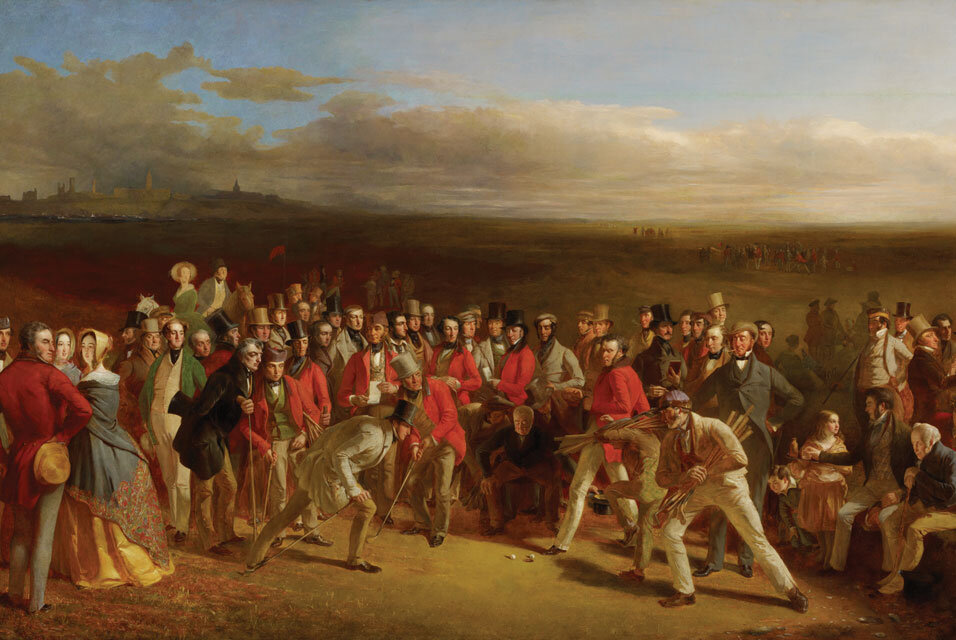
Go back to the start of this story — to "The Golfers" of 1847, those red-coated gentlemen on the St Andrews links, each playing a hand-stitched bag of feathers worth more than the club in their hands. Then look at the precision-engineered, multi-layer, aerodynamically-tuned sphere in your pocket right now, a direct descendant of a happy accident with a scuffed guttie and a wound-up pile of rubber bands in Ohio.
Every era of that journey was really about the same two things: making the ball fly better, and making the game open to more people. The featherie kept golf exclusive; the guttie threw the gates open; the Haskell and the modern ball chased pure performance; and now, in a first, the rulemakers are gently pulling the reins. Six hundred years on, the most interesting thing in your bag is still the smallest.
And that's the spirit we try to bring to coaching, too — understanding why your equipment does what it does, so you can make smart choices for the golfer you actually are. The ball has come a very long way. Hit it well.
Sources & References
- Scottish Golf History. "Golf Ball — From Hairy to Haskell." scottishgolfhistory.org
- Encyclopaedia Britannica. "Golf." britannica.com
- Future Museum (South West Scotland). "Featherie golf ball." futuremuseum.co.uk
- Golf Heritage Society. "Featheries." golfheritage.org
- McGill University Office for Science and Society. "Gutta Percha — From Golf Balls to Root Canals." mcgill.ca/oss
- Wikipedia. "Robert Adams Paterson." en.wikipedia.org
- Engines of Our Ingenuity (University of Houston), No. 3058. "Bounding Billies." engines.egr.uh.edu
- The R&A / The Open. "Sandy Herd, the Champion Golfer of 1902." thejourney.theopen.com
- LINKS Magazine. "Legends: Coburn Haskell." linksmagazine.com
- Wikipedia. "Golf ball" (construction, dimples, patterns, specifications, liquid center). en.wikipedia.org
- UC Riverside Physics & Astronomy FAQ (J. Baez). "Why are golf balls dimpled?" math.ucr.edu
- Golf Compendium. "The 'American Ball' and the 'British Ball.'" golfcompendium.com
- USGA. "Revised Golf Ball Testing Conditions to Take Effect in 2028" (December 2023). usga.org
- Golf Digest. "Ball rollback timeline getting closer to being pushed to 2030." golfdigest.com
- Golf.com. "USGA alters golf ball rollback plan, now joined by PGA Tour" (June 17, 2026). golf.com
- Golf Channel. "USGA, R&A to delay golf ball 'rollback' until January 2030." golfchannel.com
- The Fried Egg. "Why the USGA, R&A Paused the Proposed Golf Ball Rollback." thefriedegg.com
- Golf.com. "20 years later: Insiders discuss the Titleist Pro V1 launch in Vegas" (October 2020). golf.com
- Golf.com. "Tiger Woods and the golf ball that (almost) changed it all" (Nike Tour Accuracy). golf.com
- GolfWRX. "Remember these great golf balls of years past?" (Strata; O'Meara's 1998 majors). golfwrx.com
- Golf Monthly. "A Brief History of the Golf Ball." golfmonthly.com
- Astronomy.com. "Alan Shepard smacked golf balls on the Moon — and now we know where they landed" (2021). astronomy.com
- Today's Golfer. "Harry Vardon's US Open-winning golf ball sold for record price." todays-golfer.com
- Wikipedia. "Mike Austin (golfer)" (515-yard drive). en.wikipedia.org