The event has a date.
So should your practice.
Tell your coach when it is. Every round you play between now and then sharpens the read, and the plan is built against the date rather than against last week’s mood.
First 30 days free, then $50/month · cancel or pause anytime
Start your 30-day trial on the web with no card. Use the same account in the iPhone and Android apps. The trial ends without a charge; continue only if you choose a paid membership.
You have a season. Your practice has a Tuesday.
Everything else you own is organised around the event. Your tee times, your entry, your holidays. The one thing that isn’t is the practice — which stays a loose collection of whatever felt wrong most recently.
Peaking in June for an August event. The technical work lands beautifully eight weeks early, then unravels while you keep tinkering with it.
Knowing the course, not your numbers on it. You could draw every green from memory and still not say which three holes take a stroke off you every single time.
A first tee with no routine attached. Twenty minutes of whatever the range dictates, then the most pressured tee shot of your year.
Working backwards from the event
Your goal is written in your own words — “win the club championship in August” is a goal here — and the coaching orients around it from there.
Months out
Find the real gaps
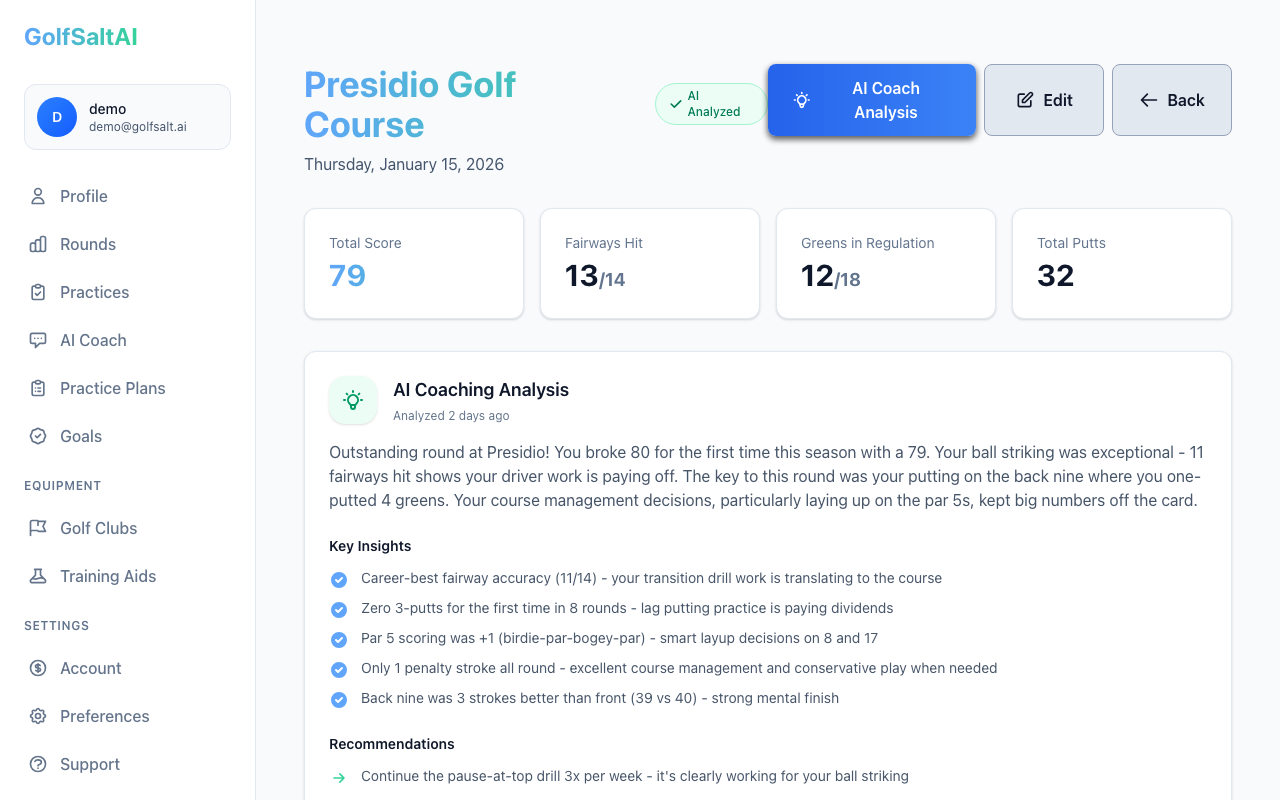
Rounds go in, analysis comes back. You get the two or three things that actually cost you strokes on this course — not the ones that annoy you most.
Mid-season
Practise against them
The plan runs over a dated window and gets rebuilt from each new round, so the work follows the evidence rather than the last bad shot.
Final weeks
Sharpen, don't rebuild
Attention moves to scoring shots, course strategy and a warmup you can repeat. Technical overhauls this close to the date rarely survive the first tee.
The week itself
Prep the actual course
Preparation notes for the course and the conditions, a warmup built for the time you'll really have, and a plan for the holes that have cost you before.
Plans that sequence automatically and step up in difficulty as a date approaches are in early testing with a small group right now — so that part may not be switched on for your account yet.
You know the course. Do you know your numbers on it?
Playing the same eighteen holes fifty times a year is an enormous advantage that most members never cash in, because familiarity feels like knowledge and isn’t.
Log the rounds and your coach reads them as a body of evidence about one specific course: which holes cost you across a season, which par 5s you’ve been playing wrong, where the safe miss actually is, and what your scoring has done month over month.
- The three holes that quietly take a stroke every time
- Which par 5s reward the second-shot decision you keep not making
- Where your miss is fine and where it's genuinely dead
- How your scoring on this course trends across the season
First 30 days free, then $50/month · cancel or pause anytime
Start your 30-day trial on the web with no card. Use the same account in the iPhone and Android apps. The trial ends without a charge; continue only if you choose a paid membership.
Preparation notes, before you tee off
Notes written for the specific course and the conditions on the day — what to expect, what to avoid, and what the round asks of your game in particular.
A warmup for the time you have
Forty minutes or twelve. The routine is built for the window you’ve actually got, with the drills, the equipment list and the mental prep, so it’s repeatable when it matters most.
Your pro stays your pro
If you’re playing at club championship level you almost certainly have someone you work with, and they’re better placed than any software to see what your swing is doing. We’re not in that job.
What we are is the layer between lessons: the season-long record, the practice in between, and the analysis of rounds nobody else was there for. You can invite your pro in and choose exactly which surfaces they see — and turn any of it off again whenever you like.
A 10.3 index already using strokes-gained tools, asking the question those tools don't answer:
How does someone with a low double-digit handicap play their par-5s better, as part of my improvement plan?
A club golfer on TheSandTrap
A small room, and a loud one
Club golf is a fraction of the sport and a large share of its gravity.
<8%
of on-course golfers are private club members
NGF, 2025
+50%
growth in private club golfers since 2019
NGF, 2025
$11,718
average annual club dues
PBMares club benchmarking, 2023
~920K
Index holders who played a competitive round
USGA (derived), 2025
The fair questions
“I already have a pro.”
Good — keep them. We're the layer between lessons, and your pro can be given access to what we see with permissions you control.
“I already own the tools.”
Most likely a rangefinder, a stats app and a launch monitor. None of them connect practice to a date on the calendar, and none of them read your rounds on your own course as one continuous body of evidence.
“Isn't a season plan just a spreadsheet I could build myself?”
You could, and a few people do. The part that doesn't survive a manual system is the rebuilding — a plan that changes after every round because the analysis changed is a lot of admin to do by hand in July.
Common questions
Straight answers about preparing for a date on the calendar.
How do I prepare for my club championship?
Work backwards from the date rather than forwards from whatever you practised last. Decide which two or three shots the course will actually ask of you, put your practice against those, and use the rounds you're already playing on that course as the measurement rather than range feel. GolfSalt does that part: your practice plan runs over a dated window, and it rebuilds from the analysis of each round you play in the run-up.
How far out should I start preparing for a golf tournament?
Far enough that any technical work has time to become automatic, and close enough that it doesn't peak early. In practice that means the technical block belongs months out, and the final weeks belong to scoring, course strategy, and getting your warmup routine reliable. Peaking in June for an August event is the classic error, and it happens because the calendar was never part of the plan.
How do I get better at the course I play every week?
Stop relying on familiarity and start measuring it. Most club golfers know the layout intimately and know their own numbers on it barely at all — which holes actually cost them strokes across a season, where the miss is genuinely fine and where it's dead. GolfSalt analyses your rounds on that course and answers it from your record instead of your impression.
Can I use GolfSalt alongside my club pro?
That's the intended shape of it. Your pro handles the swing in person; GolfSalt is the layer between lessons that holds the season-long context and the practice in between. You can invite your pro in and choose exactly what they see — rounds, practices, stats, swing videos, analyses, goals, practice plans — and revoke it whenever you want.
What should I do the week of a golf tournament?
Less than you think, and more of it specific. Sharpen the shots you'll actually need, walk or study the course with a plan for each hole, and settle on a warmup you can repeat under nerves. GolfSalt generates preparation notes for the specific course and conditions before you tee off, and builds a warmup for the time you'll realistically have — which on a championship morning is rarely the time you'd like.
Not quite you?
There's a page for the golfer you actually are.
Reading for golfers preparing for an event
Read the course before you play it.
Put the date in the plan
Every round between now and then is evidence. Start collecting it.
Starts with 30 days free
Start your 30-day trial on the web with no card. Use the same account in the iPhone and Android apps. The trial ends without a charge; continue only if you choose a paid membership.
© 2026 GolfSaltAI. Comprehensive golf coaching.
