No dumb questions.
Ever.
Ask in your own words. Get one thing to work on. Nobody watching, nobody sighing, nobody assuming you should already know.
First 30 days free, then $50/month · cancel or pause anytime
Start your 30-day trial on the web with no card. Use the same account in the iPhone and Android apps. The trial ends without a charge; continue only if you choose a paid membership.
You don’t have to know the words to ask the question
Golf has an intimidating amount of vocabulary and almost none of it is necessary to get a useful answer. Ask like a person.
“It goes right every time and I don't know why.”
“What club do I even use here?”
“Everyone told me something different. Who's right?”
“How do I not hold everyone up?”
“Am I embarrassing myself out there?”
All of those get a straight answer in plain language. None of them get a lecture, and none of them change how you get spoken to afterwards.
“I was fine at the range. Then I got to the first tee.”
This is the single most common experience in new golf, and it isn’t a sign that something is wrong with you.
At the range
- • Same club, over and over
- • Flat lie, perfect mat
- • No consequence to a bad one
- • Ten seconds between swings
- • Nobody waiting on you
On the course
- • A different club every time
- • Slopes, rough, sand, wind
- • Every bad one costs you something
- • Four minutes to think about it
- • A group on the tee behind
Repetition of the same swing doesn’t close that gap — variety and consequence do. That’s the sort of thing your practice plan is built around, and the sort of thing it’ll explain when it asks you to do it.
One thing. Not twelve.
The problem with learning golf in 2026 isn’t a shortage of advice. It’s that you’ve been given eleven swing thoughts by four sources and they contradict each other, so you’re trying to hold all of them at once over a golf ball.
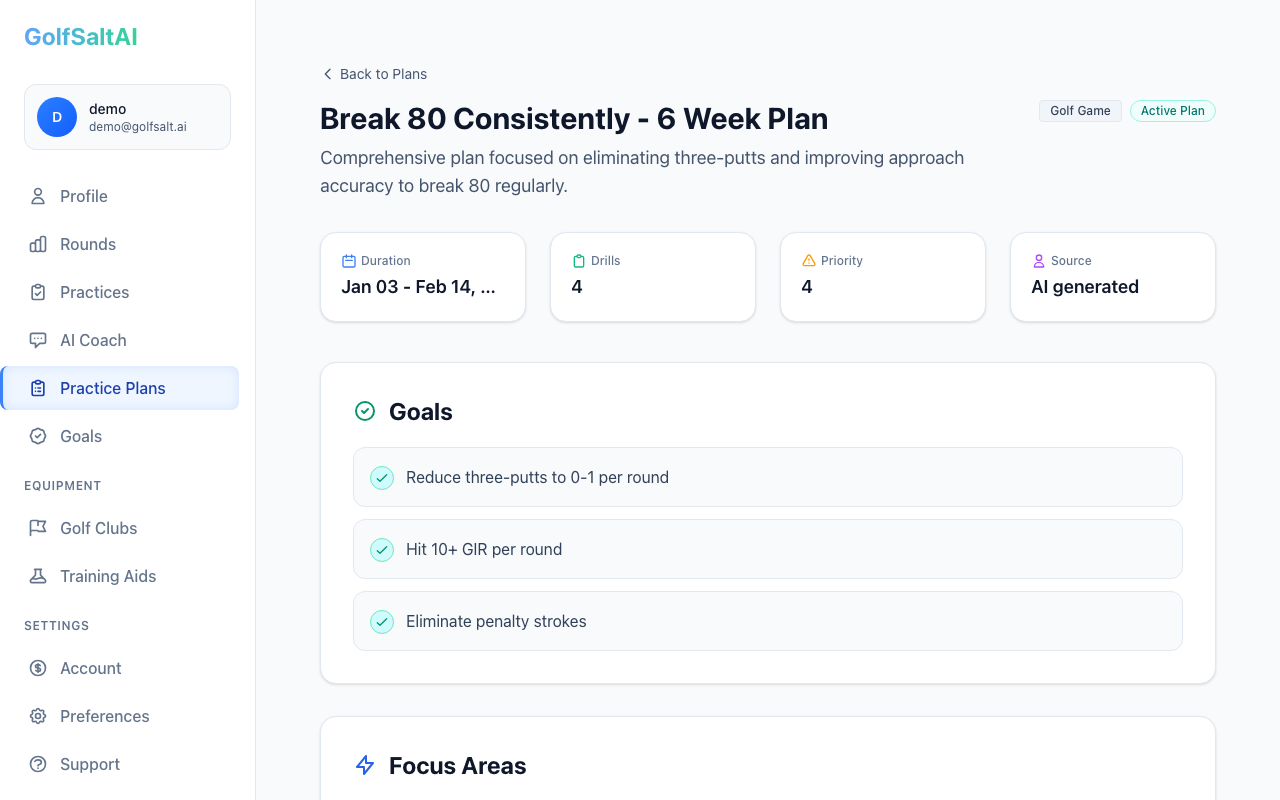
Your practice plan gives you one focus at a time with the reason attached, and changes it when your rounds say it’s time — not when a video appears in your feed.
This week
Contact before distance.
Half swings with a 9-iron, focused on hitting the ball before the ground. Because six of your lost strokes last round came from thin and fat contact, not from being short.
First 30 days free, then $50/month · cancel or pause anytime
Start your 30-day trial on the web with no card. Use the same account in the iPhone and Android apps. The trial ends without a charge; continue only if you choose a paid membership.
Your clubs are probably fine
You will be told otherwise, often, by people with something to sell. Here’s our position: at this stage your scores are decided by contact and decisions, and no purchase changes either.
There are two cheap exceptions worth checking — grips that are the wrong size for your hands, and clubs badly wrong in length for your height. Both are adjustments, not replacements.
We make nothing from equipment. No affiliate links, no brand deals, no commission. That means “keep what you’ve got” costs us nothing to say, so we say it a lot.
What this isn’t
Not a swing scanner
It won’t point a camera at you and grade your positions. You can upload a swing video and get a read on it, but the coaching is a conversation, not a scoreboard for your body.
Not a score tracker
Logging rounds is the input, not the point. Plenty of free apps will record your scores beautifully and then tell you nothing about them.
Not a social network
No leaderboards, no friends list, nobody sees how you played. The audience problem is a big part of why learning golf is hard, so we didn’t build one.
From a first-round thread — near enough word for word what we hear every week:
I warmed up at the range and was doing pretty well, but once I got on the course it's like I just forgot how to swing.
A new golfer on TheSandTrap
You are extremely not alone
Golf gains millions of new players a year, and most of them are handed nothing but contradictory advice.
3.3M
new on-course golfers a year
NGF, 2025
~75%
of beginners take no lessons at all
NGF, 2024
1 in 4
beginners go on to become committed golfers
NGF, 2023
35%
of new beginners are women
NGF, 2025
The fair questions
“Am I even good enough to need a coach?”
The coach meets you where you are. Being new is the point, not a disqualification — and there's no minimum standard you're quietly being measured against.
“Isn't this for serious golfers?”
Serious about improving is not the same as good. And your goals don't have to be about score at all — plenty of them are about enjoying the round and not feeling out of place.
“Shouldn't I just watch YouTube?”
Watch it — some of it is excellent. The trouble starts when the fourth video contradicts the first three and none of them know that your actual problem is contact rather than the takeaway they're describing.
Being straight with you
A few in-person lessons early on are genuinely worth it. Grip and setup are much easier for a professional to fix in five minutes than for you to fix from a description, and getting those right early saves years. We’d rather tell you that than pretend we replace it.
This is a paid coaching relationship, not a free app with ads. If you’re playing twice a year and want to record your scores, there are free tools that do that well and you should use one.
And it works from what you give it. Log a round and it has something to say. Log nothing and it stays general — that’s not a trick, it’s just how coaching works.
Common questions
The questions new golfers actually ask, answered without jargon.
Why do I play well at the range and badly on the course?
Because they are different activities. At the range you hit the same club from the same flat lie with no consequence and no wait between shots. On the course every shot is a different club from a different lie, with four minutes of thinking in between and people behind you. Almost everyone experiences this, it isn't a sign you're doing something wrong, and the fix is practice that introduces variety and consequence rather than more repetition of the same swing.
What should a beginner golfer practise?
One thing at a time, and usually not the driver. Contact and the shots inside 50 yards decide far more of a beginner's score than distance does. The bigger problem for most new golfers isn't choosing the wrong drill — it's trying to fix six things at once, which means none of them get a fair run. GolfSalt gives you one thing with the reason attached, and changes it when your rounds say it's time.
Do I need golf lessons as a beginner?
A few in-person lessons early are genuinely valuable — a professional can see your grip and setup in a way software cannot, and those are the two things worth getting right first. About three-quarters of beginners take none at all. GolfSalt is the coaching in between: it answers the questions you'd feel awkward asking, keeps you working on one thing, and remembers what you've been told.
Do I need to buy better golf clubs to improve?
Almost certainly not yet. A beginner's scores are dominated by contact and decision-making, not by equipment, and new clubs won't move either. The exceptions are cheap: a grip that's the wrong size for your hands, or clubs drastically the wrong length for you. GolfSalt earns nothing from equipment — no affiliate links, no manufacturer relationships — so 'what you have is fine' is a normal answer here.
Is GolfSalt suitable if I'm brand new to golf?
Being new is the point, not a disqualification. It answers in plain language rather than swing jargon, and you never have to know the right terminology to ask. The honest caveat is that it works from what you tell it — if you log almost nothing, the coaching stays fairly general, and the more rounds and sessions you record, the more specific it gets.
Not quite you?
There's a page for the golfer you actually are.
Reading for golfers new to the game
The questions everyone has and nobody wants to ask on the first tee.
Modern Golf Etiquette: A Friendly Refresher for a Game That's Still Worth Getting Right
Golf's culture is evolving and 3.4 million new golfers joined the game in 2024 alone. This is the friendly refresher on modern etiquette — pace of play, music, filming, bunkers, greens, and the small courtesies that keep the game fun for everyone.
Links, Parkland, Heathland, Desert, Stadium: How to Play Each Course Type
The style of course under your feet quietly dictates how you should play it — ground game or aerial, run it or fly it, where the real trouble hides. Here's how to read any layout, from true links to desert target golf, and adjust your game to match.
The Complete Guide to Iron Types: From Blades to Game Improvement (And Why Most of What You've Heard Is Marketing)
Blades, players cavity backs, players distance, game improvement, super game improvement — what actually separates them, why the forged-vs-cast 'feel' difference is a myth, and the one thing that matters more than any category: how your set is gapped.
Ask your first question
In your own words, with nobody watching. That's the whole starting point.
Starts with 30 days free
Start your 30-day trial on the web with no card. Use the same account in the iPhone and Android apps. The trial ends without a charge; continue only if you choose a paid membership.
© 2026 GolfSaltAI. Comprehensive golf coaching.
