You still have the swing.
It just needs a translator.
Tell us the whole story — including the version of you that played to a 2 — and get a rebuild that starts from the body you have now.
First 30 days free, then $50/month · cancel or pause anytime
Start your 30-day trial on the web with no card. Use the same account in the iPhone and Android apps. The trial ends without a charge; continue only if you choose a paid membership.
What actually changed — and it isn’t skill
The most useful thing about a long layoff is how cleanly it separates what you kept from what moved. Almost nobody does that audit, and it’s where the first season gets lost.
Still yours
- Reading a hole and picking a target
- Tempo and rhythm, once the rust is off
- Knowing what a good strike feels like
- Course sense under pressure
- The short game touch, faster than you'd expect
Quietly different
- How far you actually turn
- Speed, and therefore every carry number
- Which misses show up under pressure
- What your body will repeat forty times
- Whether your set still fits the distances you hit
Rehearsing an old motion with a changed body doesn’t restore the old swing. It builds compensations, and compensations are what that unfamiliar miss actually is.
Twenty years, in one conversation
Most golf software starts you at zero: name, handicap, go. That throws away the single most valuable thing a returning golfer has — a history.
So instead there’s a sit-down interview. It asks about the golf you used to play, what your swing did then, what stopped, what your body has been through since, and what you want out of this now. All of it becomes context your coach works from on day one.
The kind of thing it asks
Tell me about the best stretch of golf you ever played.
What did your miss look like back then?
What made you stop, and what's different about your life now?
What's your body been through since — and what does it not like doing?
What would make this season feel worth it to you?
You can stop and come back to it. It’s a conversation, not a form.
First 30 days free, then $50/month · cancel or pause anytime
Start your 30-day trial on the web with no card. Use the same account in the iPhone and Android apps. The trial ends without a charge; continue only if you choose a paid membership.
An honest read on where you are now
Benchmarking yourself against your own past is brutal and it’s also useless — you can’t practise against a memory. What you can practise against is a current measurement.
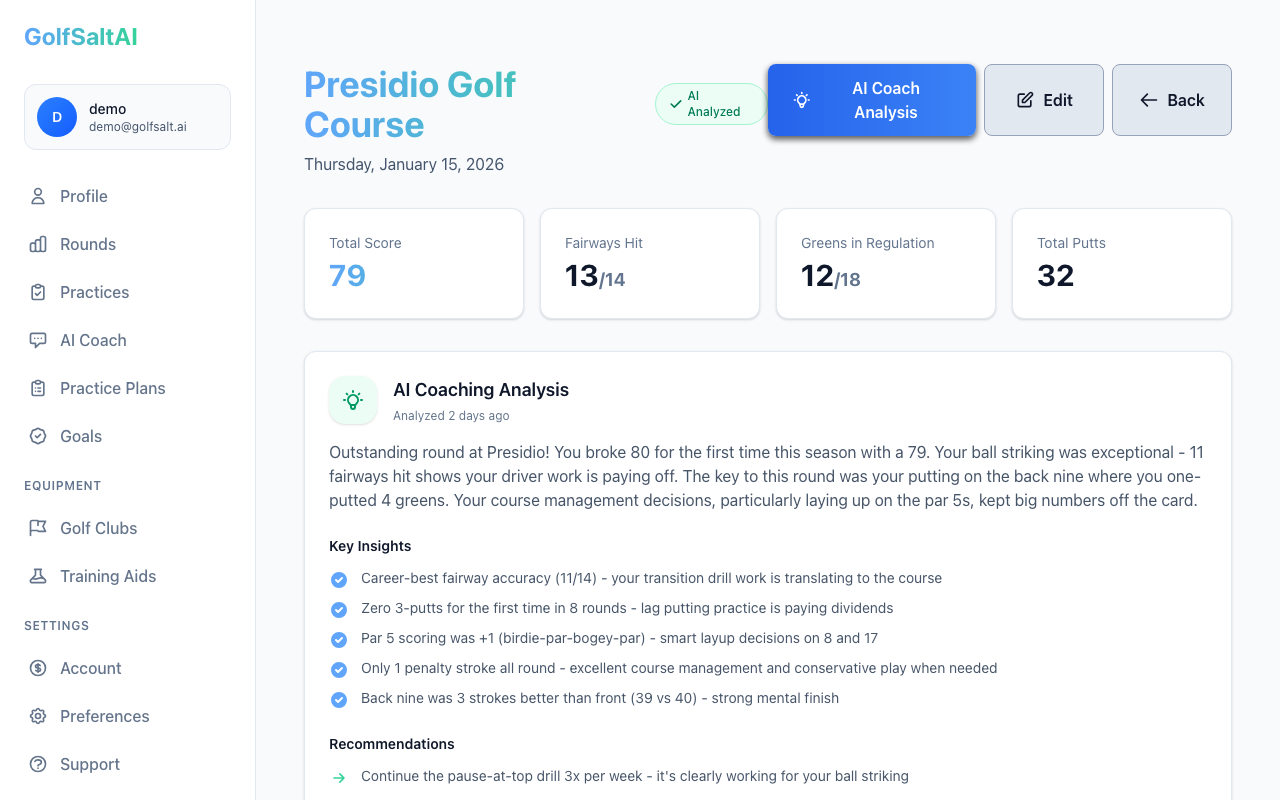
Log a few rounds and your coach tells you where the strokes are actually going now. It is frequently not where you think. Returning golfers tend to blame ball striking; the record usually points at wedges, three-putts, and one hole a round that goes sideways.
And it keeps the arc. A comeback is a long curve, and your coach remembers where the curve started — which is the part that’s genuinely encouraging six months in.
Your old irons: the straight answer
Walk into a golf shop after fifteen years away and you will be told, warmly and at length, that everything in your bag is obsolete. Here’s our position: usually it isn’t, and new clubs are rarely the answer to a problem you haven’t measured yet.
1. Log the bag
Every club with its real specs. On a recent iPhone you can scan a club and let the app read loft, lie, length, offset, bounce and sole width off it.
2. Check the cheap stuff
Grip size and condition, lie angle, shaft. Fifteen-year-old grips are a genuine problem. Fifteen-year-old heads mostly aren’t.
3. Then look at gapping
Your set was gapped for the distances you hit at 40. If the numbers moved, that’s the conversation — and it usually means one club, not fourteen.
We take no commission on equipment. No affiliate links, no manufacturer relationships, nothing riding on your answer. When the honest answer is “your clubs are fine,” that’s the answer you get.
Rebuilding, without chasing a 25-year-old ghost
We’re not going to tell you that you’ll get your old index back. That promise gets made a lot and it isn’t ours to make.
What we’ll do is build around the player in front of us: a practice plan for the sessions you can actually do, a warmup for the time you actually have, movement work if you want it, and goals written in your own words — which for a lot of returning golfers turn out to have nothing to do with score at all.
One of the clearest posts we've read from a returning golfer:
Getting back into golf after many years of life happening. I'm 62. I've played decently with these old irons but I'm looking for more control. My misses are almost always left.
A returning golfer on TheSandTrap
You are part of a wave nobody is marketing to
Returning golfers are one of the largest inflows in the sport, and almost nothing is built for them.
2.6M
returning former players in a single year
NGF, 2023
6.0M
golfers entering or re-entering the game per year
NGF, 2023
~30%
higher annual golfer inflow 2020–25 than 2014–19
NGF, 2026
21.2M
latent-demand pool of interested non-players
NGF, 2025
The fair questions
“I know how to play. I just need reps.”
Partly true, and the reps will fix more than you expect. The other part is that your body changed and the old swing no longer fits it — and reps against a mismatch build compensations rather than remove them. That part is a coaching problem.
“Won't it just tell me to buy new clubs?”
No. We earn nothing from equipment and hold no brand relationships. Grip size, lie angle and gapping come first, and 'these are fine' is a result we're happy to deliver.
“I'm embarrassed about where my game is right now.”
There's no audience here. No leaderboard, no friends list, nobody watching your scores. It's a private conversation with a coach that has seen worse and doesn't editorialise.
Common questions
Straight answers for golfers picking it back up.
How do I get back into golf after 15 years away?
Start by separating what you kept from what changed. Course sense, tempo, and shot selection tend to survive a long break; range of motion, speed, and the swing shape your body will repeat usually do not. Most returning golfers waste the first season trying to reproduce an old swing instead of building around the current one. GolfSalt starts by taking your whole history — including how you used to play — then reads your current rounds against it.
Are my 20-year-old golf clubs still good?
Often, yes — more often than the golf industry would like you to believe. Shafts and heads from two decades ago still work; what usually needs attention is grip size and condition, lie angle, and whether the set is gapped for the distances you carry now rather than the ones you carried then. GolfSalt looks at those adjustments first and will tell you plainly when your clubs are fine. We take no commission on equipment, so there's nothing in it for us either way.
Why can't I play like I used to?
Usually because two things drifted apart: the swing you remember and the body executing it. Rehearsed muscle memory for a motion your shoulders or back no longer make freely produces compensations, and compensations produce a miss that feels unfamiliar. That's a coaching problem rather than a reps problem — the reps are reinforcing the mismatch.
Do I need lessons again, or can I just play my way back?
Playing your way back works for the parts that came back on their own. Where it usually stalls is the mismatch between the old motion and the current body, because you can't see it from the inside. GolfSalt gives you the honest read on where your strokes are actually going now, and if you decide you want in-person help, you can give your instructor access to everything it's seen.
Will I get back to the handicap I had before?
We're not going to promise you that, and anyone who does is selling something. What we can do is show you truthfully where your game is now, what is realistically moveable, and what progress looks like from here — which for most returning golfers turns out to be more motivating than chasing a number they set at 25.
Not quite you?
There's a page for the golfer you actually are.
Reading for golfers coming back to the game
What changed while you were away, and what didn't.
Coming Out of Winter: The Complete Guide to Starting Your Golf Season Right
Your body needs a ramp-up, not a launch. Here's how to safely rebuild your swing, set realistic expectations for early rounds, navigate spring course conditions, and build a season plan that leads to your best golf by summer.
Golf Keeps Rewriting Its Own Rulebook: The Big Rule Changes That Reshaped the Game
The flagstick has been governed three different ways. The club limit used to be "however many your caddie can carry." A longer-flying ball was legal in Britain and illegal in America for 38 years. Here's the full history of golf's biggest rule changes — and where the ball rollback actually stands right now.

From Feathers to the Moon: The Surprisingly Wild History of the Golf Ball
Boiled goose feathers, a statue of a Hindu god, a pile of rubber bands, and a 6-iron on the Moon. The little ball in your pocket has the strangest backstory in sports — here's the whole tale, era by era, myths busted and all.
Tell your golf story
Start with the history you already have. Everything after that is built on it.
Starts with 30 days free
Start your 30-day trial on the web with no card. Use the same account in the iPhone and Android apps. The trial ends without a charge; continue only if you choose a paid membership.
© 2026 GolfSaltAI. Comprehensive golf coaching.
