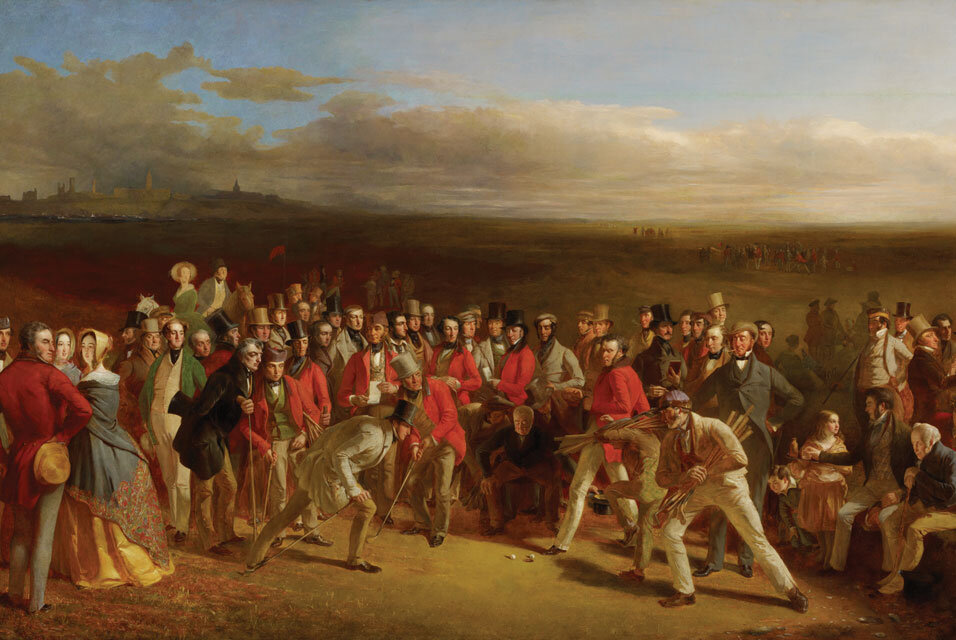
The flagstick has been governed three different ways. The club limit used to be “however many your caddie can carry.” A ball that flew farther was legal in Britain and illegal in America for nearly 40 years. Here's the full history of golf's most consequential rule changes — and where the ball rollback actually stands right now.
- Golf's rules have never been stable. Nearly three centuries of history separate the original 13 articles — written for a single 1744 tournament in Edinburgh — from today's rulebook, which grew to 34 Rules over the decades and was cut back to 24 in the 2019 rewrite. Roughly every four years, some tradition you thought was permanent changes.
- The flagstick has had three regimes. Two-stroke penalty if your putt hit it → remove it or have it tended → since 2019, leave it in with no penalty at all. The stated reason wasn't fairness. It was pace of play.
- The 14-club limit was an equity rule, not a skill rule. When the USGA surveyed its 1935 championships, the average player was carrying more than 18 clubs and caddies were hauling 35-plus pounds. The limit landed in 1938 (USGA) and 1939 (R&A) and has survived every equipment evolution since.
- The rollback is not what most golfers think it is, and it is currently paused. In June 2026 the USGA, R&A, PGA Tour and DP World Tour jointly agreed that nothing changes before January 2030 — and that the original ball proposal probably wasn't enough. USGA CEO Mike Whan said so out loud.
- Almost every rollback in golf history barely touched recreational players. Grooves, COR limits, anchoring, the small ball — each was aimed at the top of the game. The current ball projections are 13–15 yards off the longest hitters and five yards or less for the rest of us. Do not stockpile golf balls.
Why This Is Suddenly Worth Understanding
For most of us, the Rules of Golf feel like weather. They exist, they're occasionally inconvenient, and somebody in your group claims to know them better than they do. You learn a handful, you fudge a few, and you get on with it.
Then something happens that makes you realize the rulebook is a living document written by people who argue with each other. In May 2025, the drivers belonging to Rory McIlroy and Scottie Scheffler — the two best players on the planet — were declared non-conforming during routine testing at the PGA Championship. Both had to switch clubs. Scheffler won anyway, by five.
Then in June 2026, at the U.S. Open, golf's governing bodies released a joint statement that stopped the long-promised golf ball rollback in its tracks. Nothing changes until at least January 2030. And the reason they gave was startling: the fix they'd spent the better part of a decade designing might not actually work.
That's the moment to zoom out. Because if you've been treating the rollback as an unprecedented act of governance, it helps enormously to know that golf has done this over and over. It has banned putting styles. It has banned clubs and then unbanned them. It has run two different legal ball sizes on two continents. It has told you to remove the flagstick, then told you to leave it, and never apologized for either.
Let's go through the whole thing — how rules actually get made, the playing rules that changed, the equipment rules that changed, and then exactly where the rollback stands and what (if anything) you should do about it.
There are really two rulebooks in golf, and confusing them causes most of the arguments. The Rules of Golf govern how you play — where you drop, what's a penalty, what you can touch. The Equipment Rules govern what you're allowed to play with — ball specs, clubface springiness, groove geometry. The rollback is an equipment rule. The flagstick is a playing rule. They move on different timelines, through different processes, with different politics.
Foundations: How Golf's Rules Actually Get Made
1744: Thirteen articles for one tournament
The first known written rules of golf weren't an attempt to codify a sport. They were tournament conditions. The Gentlemen Golfers of Leith — later the Honourable Company of Edinburgh Golfers — drafted 13 articles in 1744 for the first Challenge for the Silver Club at Leith Links.
Read them today and they're both charmingly primitive and surprisingly durable. You tee your ball within a club length of the hole. You play the ball as it lies. You don't change the ball you started the hole with. If you lose a ball, it's stroke and distance. Two and a half centuries later, most of the modern rulebook is still an elaboration of those ideas.
1952: The two rulebooks become one
For a long stretch, golf had two authorities that disagreed. The R&A governed most of the world; the USGA, founded in 1894, governed the United States and Mexico. They did not always agree, and when they didn't, the game genuinely diverged — different legal putters, different legal ball sizes.
In 1952 the two bodies issued the first jointly agreed code of the Rules of Golf. That single act is more important than most of the individual rule changes on this page, because it created the mechanism through which all subsequent changes had to pass: two organizations, on two continents, having to agree.
2019: The great simplification (34 Rules → 24)
The 2019 edition was the most comprehensive rewrite since 1744. Six years in the making, it restructured the rulebook from 34 Rules down to 24, rewrote the language in shorter sentences with bulleted lists and plain phrasing, and consolidated relief procedures that had accumulated over decades.
The USGA and R&A framed it as modernization: make the rules understandable to people who aren't rules officials. It is genuinely more readable than what came before. It also produced a burst of confusion in 2019 as tour players collided with brand-new rules on live television — which we'll get to.
The four-year cycle and the pressure-release valve
The Rules are now revised on a roughly four-year cycle. The 2019 edition gave way to the 2023 edition, which is authoritative through the end of 2026. That cadence is deliberate: it lets questions accumulate, get studied, and get answered in batches rather than by constant amendment.
But four years is slow when a controversy erupts, and that's where Model Local Rules (MLRs) come in. An MLR is a pre-written, optional rule that the governing bodies publish and a Committee — a tour, a state association, your club's tournament committee — can choose to adopt. This is golf's pressure-release valve. It lets elite competitions play by stricter conditions without imposing them on the rest of us, and it lets recreational golf take relief options that would never survive at a U.S. Open.
If you understand Model Local Rules, you understand modern golf governance. Almost every recent flashpoint — driver length caps, greens books, the alternative to stroke and distance, the six changes the PGA Tour adopted in 2026 — arrived as an optional rule that specific competitions opted into. The governing bodies have gotten very good at changing the game for 0.01% of players without changing it for you.
Part One: The Playing Rules That Changed
The flagstick: three completely different regimes
This is the one Charley's instinct was right about, and it's the best example on the list because most golfers under 40 have only ever known the third version.
Regime one — the flagstick had to come out. For most of golf's codified history, you could not hole a stroke played from the putting green with the flagstick in the hole. If your putt from on the green struck the unattended flagstick, that was a two-stroke penalty in stroke play. The flagstick was, functionally, an obstacle you were required to remove.
Regime two — tending. The workaround, which became the norm, was to have a caddie or playing partner attend the pin: hold it, then pull it after the ball was struck. This is why old tour footage is full of caddies crouched at the hole. It's also why the rule was quietly a disaster for pace of play in amateur golf, where nobody has a caddie and every long putt required somebody to walk to the hole, pull the pin, walk it off the green, and walk back.
Regime three — leave it in (2019). Under Rule 13.2a(2), there is no penalty if a ball played from the putting green hits a flagstick left in the hole. You may still remove it. You may still have it tended. Or you can just putt.
The USGA was refreshingly blunt about the motivation. Not fairness, not tradition — pace of play. Allowing a player to putt with the flagstick in without fear of penalty should generally help speed up play, particularly in the enormous share of golf played without caddies. For the courtesies around tending and replacing the flag, see our modern golf etiquette guide.
Myth: “Leaving the flagstick in is a loophole that gives you an unfair advantage — the science proves you make more putts.”
Reality: The most-cited research does point that direction. Dave Pelz ran mechanical putting-robot tests in 1990 and again in 2018 and concluded golfers hole a higher percentage with the pin in, the proposed mechanism being that a fiberglass flagstick absorbs speed from a ball that would otherwise have hit the back edge and bounced out. But be honest about the size and the caveats: it's a small effect, it depends on how the flagstick sits and leans in the cup, and it can go the other way when the stick leans toward you. If it were a genuine edge, tour players would leave the pin in on every putt. They overwhelmingly don't.
Don't pick pin-in or pin-out from a robot study. Pick it from what lets you make a committed stroke. Some golfers find the flagstick a helpful visual reference and putt more freely with it there; others find it visually intrusive on short putts and flinch. That difference is worth more strokes than the physics. The one place I'd make a firm recommendation: on lag putts from 30 feet and beyond, leave it in. You're not trying to hole it, you get a better depth reference, and you save your group real time.
The stymie: golf's most ruthless abandoned rule (1744–1952)
If you want proof that golf used to be a harsher game, look up the stymie. Under the original rules, if your opponent's ball came to rest on the green directly between your ball and the hole, that was your problem. You played it. Around it, over it, off it — but you did not get to ask them to move it.
The interfering ball could only be lifted if the two balls lay within six inches of each other. More than six inches apart, and there was no provision to mark. Match play strategy included deliberately parking your ball on your opponent's line.
It died gradually. The USGA modified the rule in 1938 to allow an interfering ball within six inches of the hole to be lifted regardless of the distance between balls, eliminated stymies entirely from its own rulebook in 1950, and when the joint USGA/R&A code arrived in 1952, the stymie was gone worldwide. Today every ball on the green gets marked and lifted the moment either player wants it moved.
Croquet putting: banned because Sam Snead was too good at it (1968)
In the second round of the 1966 PGA Championship at Firestone, a 53-year-old Sam Snead double-hit a two-foot putt. His response was to reinvent putting: he stood astride the line, faced the hole, and stroked the ball croquet-style between his legs. It worked embarrassingly well. He finished T6 that week, won the following year's Senior PGA by nine, and made a T10 at the 1967 Masters at 54.
It did not sit well with the establishment — Bobby Jones among them, largely on aesthetic grounds. Just prior to the 1967 Walker Cup, USGA and R&A representatives agreed on new wording effective January 1, 1968: on the putting green, a player shall not make a stroke from astride, or with either foot touching, the line of the putt or its extension behind the ball.
Snead adapted. He moved to sidesaddle — facing the hole but standing to the side of the line rather than astride it — and finished T3 in the 1974 PGA Championship at 62. Sidesaddle was legal then and remains legal today. Bryson DeChambeau experimented with it in 2016.
Notice the pattern forming: golf's rulemakers are far more comfortable banning a method than banning a club. Croquet putting, anchoring, and the caddie-alignment rule all restrict what your body may do. Nobody's equipment became worthless. This is not an accident — method bans avoid lawsuits, avoid obsoleting consumer purchases, and avoid the manufacturer fight that equipment bans always trigger.
Anchoring: the 2016 ban that isn't an equipment rule
Long putters braced against the sternum appeared in the 1980s; belly putters go back at least to Phil Rodgers in the 1960s. For decades they were a curiosity for golfers who had lost their nerve on short putts.
Then they started winning majors. Webb Simpson took the 2012 U.S. Open, Ernie Els the 2012 Open Championship, and Adam Scott the 2013 Masters using anchored strokes. Three majors inside 12 months turned a curiosity into a governance problem.
Rule 14-1b took effect January 1, 2016. The critical detail — and the part people still get wrong — is that it bans the stroke, not the club. Long putters and belly putters remain entirely legal, up to the 48-inch limit that applies to every club except the driver. What's prohibited is holding the club, or a gripping hand, against your body to create a fixed pivot point.
Which is why arm-lock putting, popularized by Matt Kuchar and now used across the tour, survives: pressing the grip against your forearm is not anchoring against your body. The rulemakers wrote a method rule, and players found the legal method that got closest to the banned one. That's how golf works.
Caddie alignment: the rule that broke in public (2019)
The 2019 rewrite introduced Rule 10.2b(4): your caddie may not deliberately stand on or close to an extension of your line of play behind the ball once you begin taking your stance. The intent was to stop the practice of a caddie standing behind a player to check alignment before every shot.
It went badly, fast. Haotong Li was penalized on the 18th green in Dubai in January 2019. Days later, Denny McCarthy was penalized at the Waste Management Phoenix Open after his caddie stood behind him before an approach.
McCarthy's penalty was rescinded, and in early February 2019 — five weeks into the new rulebook — the USGA and R&A issued a clarification with two key points: backing away from your stance and resetting means you never “began a stance,” so no breach occurs; and the caddie must be deliberately standing there, aware that you're taking your stance.
It's a useful reminder that even the most carefully workshopped rule rewrite in 275 years needed an emergency patch within weeks. And it's a good argument for humility when the next change lands.
Stroke and distance gets an alternative (2019, MLR E-5)
This one deserves far more attention from recreational golfers than it gets, because it's the single largest pace-of-play tool available to you and hardly anyone uses it.
Model Local Rule E-5, effective January 1, 2019, gives a Committee the option to allow this: instead of walking back to replay your shot after a ball lost outside a penalty area or hit out of bounds, take two penalty strokes and drop in a wide area between where the ball was estimated to have come to rest (or crossed out of bounds) and the edge of the fairway of the hole being played, no nearer the hole.
Two strokes sounds punitive until you do the arithmetic: it's designed to be roughly equivalent to what stroke-and-distance relief would have cost you anyway, minus the walk of shame. It is explicitly not permitted in professional or elite amateur competition, and the governing bodies recommend it for general and casual play. It cannot be used for an unplayable ball, or when your ball is known or virtually certain to be in a penalty area.
If your regular group plays a “provisional-ish, just drop it around there” house rule for lost tee shots — and most groups do — you're already playing something close to MLR E-5, just less accurately. Ask the course or competition Committee whether E-5 is in effect before using it. When it is, following the real version gives you a defensible score; check the applicable handicap guidance before posting your round, too. Made-up relief produces made-up handicaps and made-up statistics, and then you're coaching yourself off fiction.
The rest of the 2019 batch
The 2019 edition contained 37 significant changes. The ones you actually encounter:
| Change | Before 2019 | After 2019 |
|---|---|---|
| Drop height | Shoulder height | Knee height |
| Ball search time | Five minutes | Three minutes |
| Water hazards | “Water hazards” only | Renamed penalty areas; Committees can include deserts, jungles, lava fields, dense scrub |
| Touching sand in a bunker | Broadly prohibited | Allowed to touch/move loose impediments and incidentally touch sand; still can't test conditions or ground the club right behind the ball |
| Repairing the green | Ball marks and old hole plugs only — spike marks off limits | Repair almost any damage: spike marks, shoe damage, animal damage, flagstick damage, maintenance scrapes |
| Accidental double hit | One-stroke penalty | No penalty — counts as one stroke |
| Accidentally moving your ball on the green or while searching | Penalty | No penalty; replace it. You're not responsible unless it's virtually certain you caused it |
| Rangefinders | Prohibited unless a Local Rule allowed them (option added 2006) | Permitted by default under Rule 4.3, unless a Local Rule prohibits them. Distance only — no slope, wind, or temperature |
That rangefinder flip is a small masterclass in rule design. Before 2019, using a rangefinder without an enabling Local Rule was a breach — and countless club golfers had no idea their event hadn't adopted one. Reversing the default matched the rule to what golfers were already doing and eliminated an entire category of accidental violation.
The 2023 batch
- Back-on-the-line relief got simpler. You now drop on the line, and the ball must come to rest within one club-length of where it struck the ground — and it may roll in any direction, including nearer the hole. Previously the geometry produced re-drop after re-drop and confused nearly everyone.
- Damaged clubs can be replaced. If a club is damaged during the round through anything other than your own abuse, you may replace it. The old rule — play on with a broken club or play short — punished bad luck.
- No more penalty for omitting your handicap from your scorecard. Responsibility for handicap accuracy shifted to the Committee, where it always belonged.
- Rule 25 — Modified Rules for Players with Disabilities became part of the Rules themselves rather than an optional Local Rule that had to be adopted event by event. Blind players may receive help with stance and alignment; amputees may anchor the club and get help dropping or replacing a ball. These modifications had existed for more than 25 years as an add-on. In 2023 they stopped being an add-on.
That last one is the change I'd point to if someone asked whether golf's governing bodies are capable of getting better. Making disability modifications default rather than opt-in didn't change how anyone else plays. It changed who gets to play the same game as everyone else.
The 2026 batch: still changing, right now
The current cycle is not over. Effective January 1, 2026, the governing bodies published a set of new and updated Model Local Rules, and the PGA Tour adopted six changes beginning at the Sony Open. What's instructive is that nearly every one traces to a specific televised incident:
| 2026 change | What triggered it |
|---|---|
| One stroke instead of two when a player unknowingly moves their ball | Shane Lowry's practice swing fractionally moved his ball at the 2025 Open Championship; he was initially assessed two strokes despite being unaware |
| Free relief when your ball is embedded in another player's pitch mark | Recurring unfairness, including Paul Casey at the 2002 Players and Lowry again at the 2025 PGA Championship |
| Internal out of bounds applies only to tee shots, not later strokes | Players couldn't chip sideways out of trouble because internal O.B. lines installed to stop tee-shot shortcuts also caught recovery shots |
| Broader relief from immovable obstructions near greens | Broadcast infrastructure — microphone holes and the like — created lies with no recourse; the old rule effectively covered sprinkler heads |
| Repair or replace a significantly damaged club using available components | Efficiency — the previous process meant sending someone to the locker room mid-round |
| Preferred lies relief area cut from a club-length (~46 in) to a scorecard length (~11 in) | Alignment with other major tours, plus player feedback that a club-length of “lift, clean and place” was too generous |
Five of the six are Model Local Rules. Which means they apply to the PGA Tour because the PGA Tour chose them — not to your Saturday game.
Part Two: The Equipment Rules That Changed
The 14-club limit (1938 / 1939)
Before the limit, you carried what you could carry — or more precisely, what your caddie could carry. When the USGA surveyed the fields at its 1935 U.S. Open and U.S. Amateur, the average competitor was using more than 18 clubs. Some carried well past 20.
The USGA named three concerns, and they're worth listing in full because only one of them is about competitive integrity:
- “De-skilling” the game. If you have a club for every conceivable distance and lie, you never have to invent a shot. The rulemakers thought that made skill less prominent.
- Inequality. Wealthy golfers could buy 22 clubs. Everyone else could not. The limit was, in plain terms, an equity measure.
- Caddie welfare. Bags were exceeding 35 pounds, carried for 18 holes, by people who were often teenagers.
The USGA adopted the limit effective January 1, 1938; the R&A followed on May 1, 1939 — another instance of the two bodies moving at different speeds before 1952. As for why 14: the widely accepted explanation is that it reflected the common set makeup of the day, roughly four woods, nine irons and a putter. Bobby Jones and Tony Torrance were influential in both the limit and the number.
Myth: “The 14-club rule exists to keep the game hard.”
Reality: Two of the USGA's three stated reasons were about fairness to golfers who couldn't afford more clubs and about the human beings carrying the bags. It's one of the most socially motivated rules in the book, and it was written in 1936 — which is worth remembering when someone tells you golf's rulemakers have never cared about access.
The practical modern consequence: you almost certainly have a slot in your bag doing nothing. Most golfers I look at are carrying a 4-iron they can't launch and a gap in their wedges. The limit is a ceiling, not a requirement — and it's a genuinely useful constraint, because it forces you to decide which distances you actually need covered.
The great ball-size split (1932–1990)
For nearly six decades, golf ran two legal balls. The 1952 joint code standardized both: the American ball at no less than 1.680 inches in diameter, and the British “small ball” at no less than 1.620 inches, usable outside the United States and Mexico.
The small ball flew farther and cut through wind better. American players heading to the Open Championship routinely switched to it for the week. Attempts at compromise failed — a 1.660-inch middle ground was floated in September 1970 and abandoned in 1973 after three years of argument. The R&A banned the small ball from its own championships, including the Open, in 1974, and finally outlawed it entirely on January 1, 1990.
Think about what that means. For 58 years, the legality of your golf ball depended on which side of the Atlantic you were standing on. If you want a precedent for bifurcation — different equipment rules for different competitions — golf has already run that experiment, at scale, for most of the 20th century. (For the full ball story, from boiled goose feathers to the Pro V1, we went deep on it in the history of the golf ball.)
Distance standards: 1942, 1976, and today
The rollback is often described as unprecedented. It isn't. Golf has been capping ball distance for more than 80 years.
- 1942 — Initial Velocity standard. The USGA imposed a velocity limit designed to freeze the ball's distance qualities at 1941 levels.
- 1976 — Overall Distance Standard (ODS). Effective March 1, 1976, the USGA and R&A capped total distance — carry plus roll — on a standardized test apparatus. The original figure: an average not exceeding 280 yards, plus an 8% tolerance. The stated purpose was to limit future technological development aimed at increasing distance.
- Today. The ODS limit sits at 317 yards with a 3-yard tolerance, measured under specified launch conditions.
The ODS is the mechanism the rollback modifies. Not the yardage limit — the test conditions. Which is the single most misunderstood thing about the whole debate, and we'll unpack it below.
Grooves, and the strangest loophole in golf history (2010)
Square (U-shaped) grooves generate more spin than V-grooves, particularly from the rough — which reduces the penalty for missing a fairway. In 1990, Ping sued the USGA over square grooves. It settled out of court, and the settlement grandfathered Ping's clubs made before April 1, 1990, provided they weren't altered.
Twenty years later, the USGA's new groove rule took effect in 2010, and the PGA Tour adopted a condition of competition enforcing it. Which created a genuinely absurd situation: Ping Eye 2 wedges manufactured between 1985 and 1989 were still legal under the old settlement while every modern square-grooved wedge was banned. Phil Mickelson put an old Eye 2 wedge in play. John Daly played a 1986 set at the 2010 Sony Open. Scott McCarron publicly accused Mickelson of cheating. Nobody was breaking a rule; the rules were just contradicting each other.
Ping resolved it by voluntarily waiving its settlement rights in March 2010, allowing the Tour to ban the old clubs going forward. A quarter-century-old lawsuit had to be un-settled before a rule could function.
The groove saga is the best available evidence for why the governing bodies move slowly on equipment. Every equipment rule has a manufacturer on the other side of it, with lawyers, inventory, tooling, and consumers who just spent money. When you see an eight-year study followed by a seven-year implementation runway, that's not indecision. That's an institution that has been sued.
Spring-like faces: COR, CT, and “CT creep”
A thin, flexible driver face acts like a trampoline, returning more energy to the ball. The rules cap it.
- 1998: The USGA set a coefficient of restitution (COR) limit of 0.822 with a 0.008 test tolerance — effectively 0.830.
- 2003: The R&A introduced the limit as a Condition of Competition at the Open Championship, and applied it to all players from January 1, 2008. Another five-year transatlantic gap.
- 2005: The USGA adopted the portable Characteristic Time (CT) test, still used today. A pendulum swings a steel ball into the face at several spots and measures how long the ball stays in contact. Longer contact means a springier face.
- 2004: Clubhead volume was capped at 460cc, plus a 10cc measurement tolerance.
Which brings us back to McIlroy and Scheffler at the 2025 PGA Championship. Their drivers weren't illegal by design. They suffered CT creep: repeated high-speed impacts fatigue the metal, the face gets slightly more flexible, and eventually a spot on the face exceeds the limit. Both were among roughly 50 players tested at Quail Hollow. Both had to swap.
CT creep is real physics, not a tour-only curiosity — but the honest answer for almost every reader is that it doesn't affect you. It requires very high clubhead speed and a very large number of impacts to move a face meaningfully. If you swing 105+ mph, hit hundreds of balls a week, and have had the same driver for several seasons, a face that's crept slightly hotter is a theoretical possibility. That is not a reason to buy a new driver. It's a reason to be skeptical when someone tells you your driver “went dead” — far more often that's a shaft, a setup drift, or a strike-pattern change, and those are all free to check.
Driver length: 48 inches to 46 (MLR G-10, 2022)
Every club other than the putter had a 48-inch ceiling. As players experimented with extreme length for speed — Bryson DeChambeau's 48-inch driver testing being the visible example — the governing bodies introduced Model Local Rule G-10, effective January 1, 2022, letting competitions cap driver length at 46 inches.
Note the design: not a rule change, an option. Elite tours can adopt it. Your club can adopt it. Nobody's 47-inch driver became scrap.
Green-reading materials (2019 spec, MLR G-11 in 2022)
Ultra-detailed greens books mapped slope to a precision that arguably replaced the skill of reading a green. The 2019 Rules established limits on green-reading materials. Then MLR G-11, available from January 1, 2022, went further for elite competition: a Committee can designate an officially approved yardage book showing only minimal detail, and restrict the handwritten notes players and caddies may add.
Again — recreational golfers who meet the 2019 requirements can keep using green-reading tools. The tighter rule is opt-in, aimed at the top.
And the strangest equipment ban of all: the Schenectady putter (1910–1951)
Arthur Knight of Schenectady, New York patented a center-shafted, mallet-headed putter in 1903. In 1904, Walter Travis used one to become the first American winner of the British Amateur. In 1910, responding to a request from a golf club in New Zealand, the R&A banned center-shafted, mallet-headed putters.
The persistent story is that the R&A banned it out of pique at Travis's win. There's no evidence for that, and the USGA's own history says so. What is significant is what happened next: the USGA declined to follow. It agreed mallet-headed clubs should be banned but ruled the Schenectady and other center-shafted putters weren't in that category. For the first time, an R&A ruling was not adopted in America.
The R&A ban stood for roughly four decades and was lifted in 1951 — one year before the two bodies issued their first unified code. If you've ever putted with a center-shafted mallet, you're using a club that was illegal in Britain and legal in America for 41 years.
Part Three: The Rollback — What It Actually Is, and Where It Actually Stands
Now the one everybody's arguing about. And here's where accuracy matters most, because the reporting has shifted three times and a lot of what's circulating is out of date.
What the rollback actually changes
The rollback does not lower the 317-yard ODS limit. It changes the conditions the ball is tested under — making the test more demanding, so balls optimized for very high speeds fail it.
| Test condition | Current standard | Proposed standard |
|---|---|---|
| Clubhead speed | 120 mph | 125 mph |
| Ball speed | 176 mph | 183 mph |
| Spin rate | 2,520 rpm | 2,220 rpm |
| Launch angle | 10 degrees | 11 degrees |
| ODS limit | 317 yards (+3 tolerance) | 317 yards (+3 tolerance) — unchanged |
The current test conditions were set roughly two decades ago and no longer resemble how elite players actually launch the ball. Testing at 125 mph with lower spin and higher launch is much closer to a modern tour drive — and a ball that stays under 317 yards under those conditions has to give something up at the top end.
The projected distance losses, from the governing bodies' own December 2023 figures:
| Player group | Projected distance reduction |
|---|---|
| Longest elite hitters | 13–15 yards |
| Average PGA Tour / elite male | 9–11 yards |
| Average LPGA / LET | 5–7 yards |
| Recreational golfers | 5 yards or less |
And a detail that gets almost no airtime: more than 30% of currently conforming golf balls would still conform under the new standard. The rollback was never going to obsolete the ball in your bag.
The timeline, three versions of it
This is where most articles you'll find online are wrong, because they were written before the plan changed.
- December 2023 — the original plan. Revised ODS testing conditions effective January 2028 for conformance, with balls approved through 2027 usable recreationally until January 2030. A staggered, two-date rollout: elite golf first, everyone else later.
- Early 2026 — consultation. The governing bodies sought comment on the implementation date and proposed collapsing it to a single universal date of January 1, 2030, citing feedback from a wide range of stakeholders. Notably, this was the first time the PGA Tour and DP World Tour stood alongside the USGA and R&A on the issue rather than opposing them.
- June 17, 2026 — the pause. In a joint statement at the U.S. Open, the USGA, R&A, PGA Tour and DP World Tour announced that there will be no change to ODS testing until at least January 2030, and that they will reassess the approach entirely.
The stated reason for the pause is remarkable candor from a governing body. The concern was that the proposed change wasn't enough. USGA CEO Mike Whan called the ball change “a small, digestible bite that the industry can handle” and acknowledged it “probably isn't enough.” Asked about it directly, he said: “A concern was that it maybe wasn't enough.”
He was not speaking in a vacuum. Cameron Young reported testing a ball built to the proposed specification and not losing meaningful distance — then hit a 375-yard drive at the 2026 Players Championship. When one of the longest hitters in the world can play the rolled-back ball without noticing, the rollback has a problem.
The governing bodies' joint statement committed to working with the tours and their members to “review, test and implement options that have a meaningful impact on distance at the elite level.” Whan framed the pause as “an opportunity to think bigger” and said a “simpler, more narrow solution is exactly what we're going to spend time looking at.”
What's actually on the table now
- Driver regulation. The June 2026 statement suggested that whatever arrives in 2030 will likely require more than ball restrictions — possibly including driver head shape or face thickness. Given that CT creep already causes tour drivers to fail testing, this is the obvious next lever.
- Bifurcation, back from the dead. Different equipment rules for elite competition versus everyone else — long resisted, particularly by the PGA Tour — is openly discussed again. The mechanism already exists: a Model Local Rule. Critics argue it violates golf's foundational principle that we all play the same game by the same rules. Supporters point out that golf ran two legal ball sizes for 58 years and survived.
- Doing something narrower and sharper. Whan's language suggests appetite for a targeted intervention rather than a broad one.
Myth: “The rollback is coming in 2028 and my golf balls are about to become illegal.”
Reality: As of August 2026, nothing changes before January 2030 at the earliest, the specific proposal has been paused for reassessment, and even the original version projected five yards or less for recreational players while leaving more than 30% of today's balls conforming. There is no version of this in which the sleeve in your bag becomes contraband. Golf's governing bodies have never done that — even the small ball got a 16-year runway between being banned from the Open and being banned outright.
The single most common rollback question I get is some version of “should I buy a case of my current ball before they change it?” No. Three reasons. First, the timeline is at minimum three and a half years out and the specification isn't settled. Second, golf balls do age — not fast in a cool, dry place, but a case bought in 2026 to use in 2032 is a worse ball than whatever you'd buy in 2032. Third, and most importantly: at recreational swing speeds this is a rounding error compared to strike quality. If you want the five yards back, the range has them, and the range is free.
What 280 Years of Rule Changes Actually Teach Us
Lay all of it out and clear patterns emerge. These are worth knowing because they let you predict what happens next better than any hot take will.
1. The rules chase skilled players, not you
Grooves, COR limits, greens books, driver length, anchoring, the ball. Every one was a response to what the best players in the world were doing. Every one was calibrated to minimize disruption to everyone else. That's not an accident of implementation — it's the explicit design goal, stated in the governing bodies' own language about “minimising the impact on the recreational game.”
2. Nothing gets banned quickly, and almost nothing gets banned retroactively
Square grooves: sued in 1990, rule in 2010, loophole closed the same year via a voluntary waiver. COR: 1998 in America, 2008 for everyone under the R&A. The small ball: banned from the Open in 1974, banned outright in 1990. The ball rollback: study begun in the late 2010s, first proposal 2023, now no earlier than 2030.
Golf's governing bodies are institutionally incapable of acting fast, and after reading the Ping saga it's hard to blame them entirely.
3. Banning a method is easier than banning a club
Croquet putting, anchoring, caddie alignment, stances astride the line. In each case the equipment stayed legal and the technique became illegal. No inventory to write off, no manufacturer to litigate against, no consumer whose purchase evaporated. Expect future distance regulation to look for method-shaped solutions wherever it can find them — though with distance, there isn't an obvious one, which is exactly why this has been so hard.
4. “Pace of play” is the most successful argument in golf governance
It won the flagstick rule. It won the three-minute search. It won the alternative to stroke and distance. It's the justification behind the 2026 damaged-club change. When a proposed change can be framed as making rounds faster, it tends to pass. When it can only be framed as making the game harder, it tends to stall.
5. Fairness and access show up more than you'd expect
The 14-club limit was partly about golfers who couldn't afford 20 clubs and caddies carrying 35 pounds. Rule 25 made disability modifications standard instead of opt-in. The 2019 rewrite existed to make the rules legible to people who aren't officials. Golf's rulemakers get accused of being aloof traditionalists, and sometimes they've earned it — but the record is more mixed than the reputation.
A Timeline You Can Actually Use
| Year | Change | Who it hit | Still in force? |
|---|---|---|---|
| 1744 | First written rules — 13 articles, Leith | Everyone | In spirit |
| 1910 | R&A bans center-shafted mallet putters (USGA declines) | British golfers only | No — lifted 1951 |
| 1938/39 | 14-club limit (USGA 1938, R&A 1939) | Everyone | Yes |
| 1942 | Initial Velocity standard for the ball | Everyone | Superseded by ODS |
| 1950–52 | Stymie abolished; first unified USGA/R&A code | Everyone | Yes |
| 1952–90 | Two legal ball sizes (1.62 in / 1.68 in) | Split by geography | No — unified 1990 |
| 1968 | Croquet-style putting banned | Everyone | Yes |
| 1976 | Overall Distance Standard introduced (280 yd + 8%) | Everyone | Yes, at 317 + 3 |
| 1998–2008 | COR / spring-like effect limit (0.830) | Everyone, staggered | Yes, tested via CT |
| 2004 | 460cc driver head volume cap | Everyone | Yes |
| 2006 | Rangefinders permitted by Local Rule | Everyone | Superseded 2019 |
| 2010 | Groove rule (square grooves out) | Elite first, then all | Yes |
| 2016 | Anchoring ban (Rule 14-1b) | Everyone | Yes |
| 2019 | Rules modernization: 34 Rules → 24; flagstick, knee drop, 3-min search, penalty areas, bunkers, DMDs by default, MLR E-5 | Everyone | Yes |
| 2022 | MLR G-10 (46″ driver) and G-11 (greens books) | Opt-in competitions | Yes, optional |
| 2023 | Back-on-the-line simplified; damaged clubs replaceable; Rule 25 for players with disabilities | Everyone | Yes |
| 2026 | Six new/updated MLRs adopted by the PGA Tour | Opt-in competitions | Yes, optional |
| 2030? | Revised ODS testing conditions — paused for reassessment | TBD | Not yet |
What You Should Actually Do With All This
Don't act on the rollback. At all.
Don't stockpile. Don't buy a “rollback-ready” ball. Don't change what you play. The specification isn't final, the date is no earlier than January 2030, and the projected recreational impact was five yards or less even under the version that got paused. Revisit this in 2029.
Learn the four current rules most golfers still get wrong
- The flagstick. You can leave it in. No penalty, since 2019. If someone in your group tells you otherwise, they're seven years out of date.
- Bunkers. You can move loose impediments — leaves, stones, twigs, a pinecone — and you can incidentally touch the sand. You still can't test the condition of the sand or ground your club immediately behind the ball.
- Spike marks and green damage. Repair nearly anything on the putting surface: spike marks, shoe scuffs, animal damage, flagstick damage, old plugs. This one is a genuine gift and most golfers still tiptoe around a spike mark like it's 2015.
- Drop height. Knee height. Not shoulder. Not waist. Knee.
Check whether MLR E-5 is in effect for your regular game
If you play casual golf, ask the course or competition Committee whether it has adopted the alternative to stroke and distance. When E-5 is in effect for your round, a lost ball outside a penalty area or a ball out of bounds can mean two penalty strokes and a drop in the specified relief area, rather than a walk back to the previous spot. Check the local rules and handicap guidance before posting your score.
Count your clubs before you tee off — and then audit them
The 14-club penalty is two strokes per hole, up to a maximum of four. It's the most avoidable penalty in golf and it happens constantly, usually because somebody was testing a club on the range and forgot. Count them.
Then do the harder audit: are all 14 earning their place? A limit written in 1936 to stop wealthy golfers from carrying 22 clubs is now, accidentally, a fitting tool. It forces you to ask which distances and which shots you actually need covered — which is a much better question than “what's the newest club I could buy.” Most golfers I look at have a redundant long iron and a 30-yard gap in their wedges. Fixing that costs nothing but a conversation; the 14-club bag guide shows how to audit the gaps.
Be skeptical of “my driver went dead”
CT creep is real, and it takes an enormous number of high-speed impacts to matter. Before you accept that your driver has gone soft or gone hot, check the boring explanations: strike location drifting toward the heel, a shaft that no longer suits your speed, a grip that's changed your hand position, a loft or lie setting somebody moved. Those are all free to investigate and vastly more likely.
Final Thought: The Rulebook Is a Conversation, Not a Monument
Golfers love to talk about the game's rules as if they were handed down complete and unalterable. They weren't. They were 13 tournament conditions written in Edinburgh in 1744, argued over on two continents for two hundred years, split into two incompatible codes and stitched back together in 1952, expanded to 34 Rules and pruned back to 24, and amended in living memory to let you leave the flagstick in the hole because pulling it was taking too long.
The people who wrote those rules have banned putting strokes because they looked wrong, limited clubs because caddies were getting hurt, run two legal balls on two continents for 58 years, needed a 20-year-old lawsuit un-settled before a groove rule could work, and — in June 2026 — stood up at their own national championship and admitted that the fix they'd spent years designing probably wasn't good enough. That last one, honestly, is the most encouraging thing in this entire article. It's a lot easier to trust an institution that will say the uncomfortable thing out loud.
So when the rollback finally arrives, in whatever form it takes, in 2030 or later — you'll know how to read it. Look at who it's aimed at. Look at the runway. Look at whether it's a Model Local Rule or a change to the Rules themselves. And then check the projected impact on a golfer with your swing speed, which will almost certainly be small enough that the honest coaching answer is the same as it always is: your next five yards are in your strike, not your sleeve.
That's the part no rule change touches. Hit it well.
Sources & References
- USGA. “A Brief History of Revisions to the Rules of Golf: 1744 to Present.” usga.org
- Leith Rules Golf Society. “Earliest Recorded Rules of Golf” (the 1744 Thirteen Articles). leith-rules-golf.co.uk
- USGA. “Summary Chart: The Major Changes in the Rules of Golf for 2019” (PDF). usga.org
- USGA. “Major Change: Ball Played from the Putting Green Hits Unattended Flagstick in Hole.” usga.org
- USGA. “Rule 13 — Putting Greens” (Rule 13.2a(2)). usga.org
- Golf.com. “2019 rules changes to know: Why the flagstick is now your friend.” golf.com
- Golf.com. “Dave Pelz: The science proves you should leave the flagstick in when you putt.” golf.com
- USGA. “Rules Throwback: Tough Putt? Try Being Stymied.” usga.org
- Golf Heritage Society. “Understanding the Lost Art of the Stymie.” golfheritage.org
- Golf Digest. “Yes, the great Sam Snead used to actually putt croquet style until it was banned.” golfdigest.com
- Golf.com. “A croquet-style stroke is illegal with a putter. But what about other clubs?” golf.com
- USGA. “Back in the Saddle: DeChambeau Adopts Putting Stroke From Snead.” usga.org
- USGA. “Rules Throwback: The Schenectady Putter.” usga.org
- New York State Golf Association. “Origins of the Schenectady Putter.” nysga.org
- ESPN. “Golf's governing bodies impose ban on anchoring putter starting in January 2016.” espn.com
- Golf Digest. “What you need to know now that the anchoring ban has finally arrived.” golfdigest.com
- Golf.com. “This is the reason that arm-anchor putting is still legal.” golf.com
- Golf Digest. “Did You Know: The origins of the 14-club limit.” golfdigest.com
- LINKS Magazine. “Why 14 Clubs?” linksmagazine.com
- Golf Compendium. “Looking Back: The ‘American Ball’ and ‘British Ball.’” golfcompendium.com
- USGA. “History of Equipment Rules” (PDF — Initial Velocity 1942, ODS 1976, COR, head size). usga.org
- USGA and R&A. “Final Rule on ‘Spring-Like’ Effect” (PDF, August 2002). usga.org
- ESPN. “Wedges with square grooves disallowed as Ping, PGA Tour reach settlement” (March 2010). espn.com
- PING. “Groove Rule” (company statement). ping.com
- Golf Compendium. “That Time a Rules Loophole Made Some PGA Tour Pros Use 25-Year-Old Wedges.” golfcompendium.com
- Golf Digest. “PGA Championship 2025: Rory McIlroy's driver deemed non-conforming by USGA ahead of Quail Hollow.” golfdigest.com
- Sky Sports. “US Open 2025: USGA stands firm on driver testing protocols despite McIlroy and Scheffler failures.” skysports.com
- Golf Channel. “USGA, R&A make local rule to cap pros' driver length at 46 inches” (MLR G-10). golfchannel.com
- USGA. “Model Local Rule to Further Limit Use of Green-Reading Materials” (MLR G-11). usga.org
- USGA. “Major Change: Use of Distance-Measuring Devices” (Rule 4.3). usga.org
- The R&A. “Model Local Rules: E-5” (Committee adoption and relief procedure). randa.org
- USGA. “Stroke and Distance: New Local Rule” (MLR E-5). usga.org
- Golf.com. “USGA, R&A release clarification of controversial caddie alignment rule” (February 2019). golf.com
- Golf Channel. “Days after Li infraction, McCarthy penalized for caddie ‘alignment.’” golfchannel.com
- USGA. “Key Changes to the Rules of Golf Set to Take Effect in 2023.” usga.org
- The R&A. “Rule 25 — Modified Rules for Players with Disabilities.” randa.org
- Golf.com. “6 rules changes the PGA Tour is enacting in 2026 (and what triggered them)” (January 2026). golf.com
- The R&A. “Decision to revise golf ball testing conditions beginning in 2028 announced” (December 2023). randa.org
- USGA. “Revised Golf Ball Testing Conditions to Take Effect in 2028” (December 2023). usga.org
- The R&A, USGA, PGA Tour and DP World Tour. “Joint statement” (June 17, 2026). randa.org
- Golf.com. “USGA alters golf ball rollback plan, now joined by PGA Tour” (June 17, 2026). golf.com
- ESPN. “R&A, USGA, tours plan golf ball rollback amid distance concerns” (June 17, 2026). espn.com
- Golf Channel. “USGA, R&A to delay golf ball ‘rollback’ until January 2030.” golfchannel.com
- The Fried Egg. “Why the USGA, R&A Paused the Proposed Golf Ball Rollback.” thefriedegg.com
- GolfPass. “New golf equipment rollback complications put the USGA and R&A in a bind” (June 2026). golfpass.com
- Golf Digest. “U.S. Open 2026: In surprise statement, USGA and R&A announce they are delaying rollback, reevaluating ‘path forward.’” golfdigest.com
- USGA. “The Golf Ball and Distance: Frequently Asked Questions.” usga.org
- Golfrules.com. “New Rules of Golf in 2019, part 1: From 34 to 24 Rules!” golfrules.com