What tempo really is, why 3:1 is an average rather than a law, why your short game runs on a different clock, what a couple of drinks actually does to your rhythm, and why badly fit clubs can quietly wreck a tempo you've worked hard to build.
- Tempo is a ratio, and consistency matters more than speed. Good players take roughly three times as long to swing back as to swing down. What really separates them in the lab is that they repeat their tempo swing after swing. A fast swinger and a slow swinger can both have excellent tempo.
- Your short game runs on a different clock. Putts and short chips sit closer to 2:1. The total stroke time stays about the same whatever the length, and the length of the stroke, not its speed, controls distance.
- The "couple of drinks" effect is mostly about tension, and it doesn't last. A small amount of alcohol can take the edge off anxiety and loosen a tight, rushed swing for a while. Alcohol also makes rhythmic timing less consistent and impairs fine motor control as the dose climbs. The useful lesson is what a looser state does for your tempo, and you can train that sober.
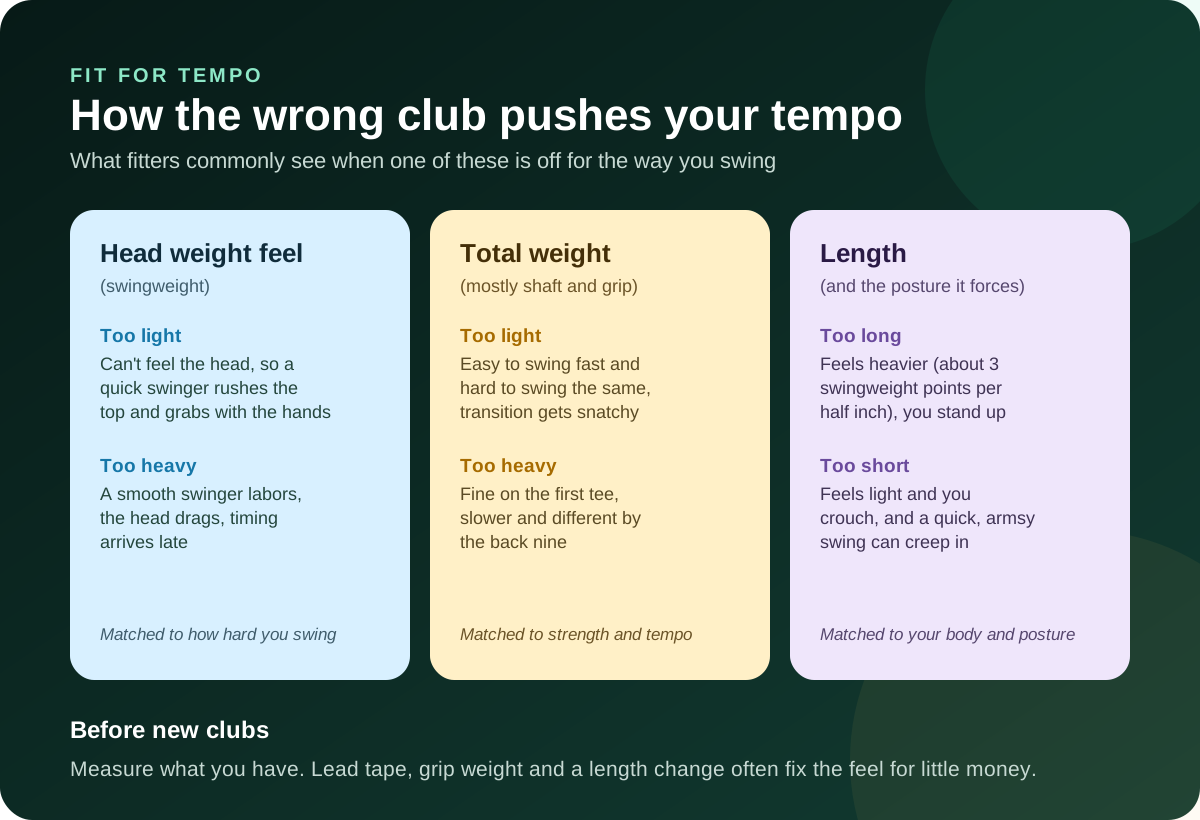
- Clubs that don't fit you can push your tempo around. Head weight that's wrong for how hard you swing, total weight that's wrong for your strength, and length that's wrong for your body all change how the club wants to move. Fitting for a repeatable tempo is one of the best reasons to be fit, and often the fix is an adjustment, not a new set.
- Train it with sound, not just feel. Controlled studies show metronome training improves timing consistency and accuracy, even in experienced golfers. A metronome, your phone's slow-motion camera and a handful of drills will take you a long way, and music can help you settle before a round.
Why tempo deserves an honest look
Tempo is one of the most repeated words in golf instruction. It's also one of the least understood. "Slow down" is probably the most common swing tip ever given from one playing partner to another, and it's often the wrong advice. It's offered after the bad shot, not before, and it treats tempo as a speed when it's really a relationship between the parts of your swing.
Here's what we see most often. A golfer's tempo is fine on the range, where nothing is at stake and the club in their hands is the one they hit every week. Then it changes, on the first tee, over a putt to save a good score, with a club that never quite felt right, late in a round when they're tired, or after the drinks cart has been round twice. Tempo is less a swing position than a state, and that's why it's worth a whole guide.
This guide is meant to be useful whether or not you ever use GolfSalt. We'll cover what tempo is and how it's measured, how to find your own, why the short game is different, what pressure and alcohol really do, how to train tempo with drills, tools and music, and the part that gets talked about least: how your equipment can make a good tempo hard to repeat.
Tempo, rhythm and timing are three different things
Golfers use these words interchangeably. The research doesn't, and the difference is practical.
- Tempo is the pace of the swing, the overall time it takes and how that time splits between backswing and downswing. Physicist Robert Grober and colleagues at Yale define it by measuring backswing duration and downswing duration directly [1].
- Rhythm is how smoothly the motion flows within that time, whether it accelerates and changes direction without jerks, stalls or snatches.
- Timing is how the pieces arrive together, the body, arms and club reaching impact in the right order.
Grober's later work treats all three as separate things to measure with sensors in the shaft [2]. An older study of golfers across age groups found that tempo and rhythm are not independent, and that "changing one's tempo may disrupt rhythm" [3]. That's the research version of something every coach has seen: tell a golfer to swing slower and the swing often becomes stiff, guided and late at the bottom.
Good tempo is not slow tempo. It is a ratio you can repeat at a pace that suits you. If you change the speed, you have to keep the proportions, or your rhythm and timing go with it.
The 3:1 ratio: where it came from and what it really says
Tour Tempo and the frame counts
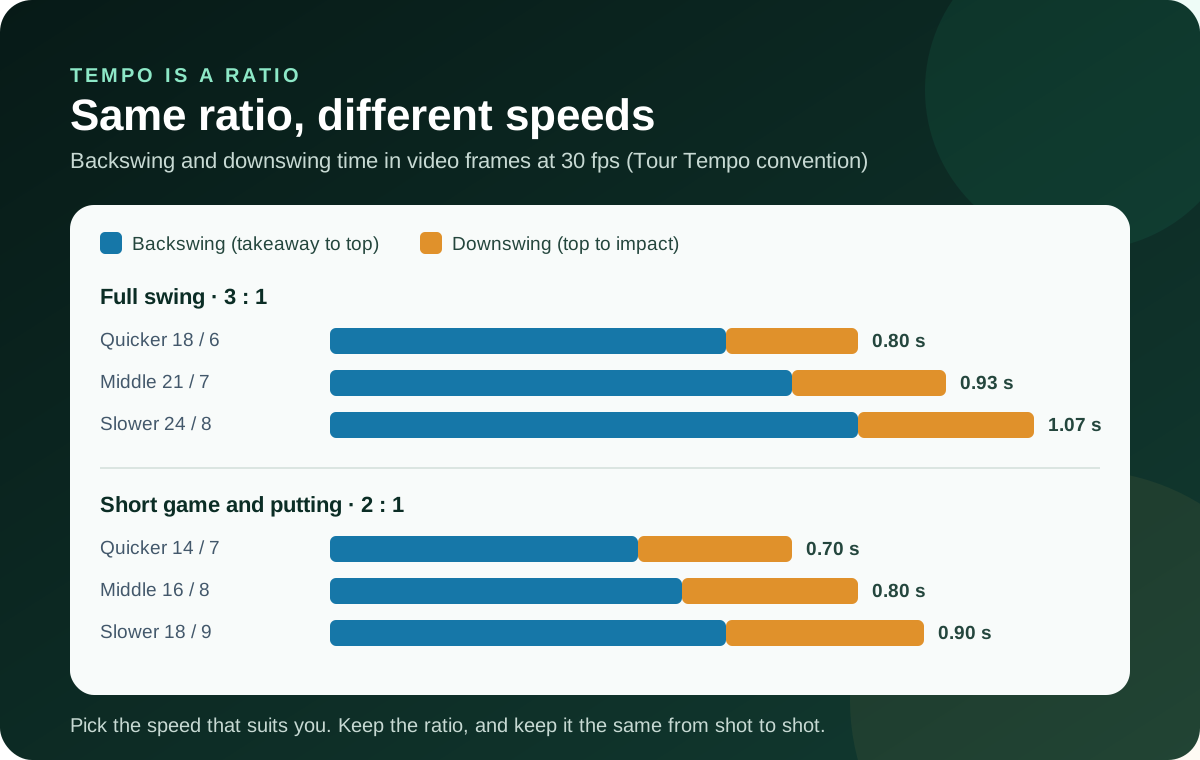
In the early 2000s John Novosel used ordinary 30-frames-per-second video to time tour players from takeaway to the top and from the top to impact. Working with John Garrity, he published the findings as Tour Tempo. Most of the players took about three times as long going back as coming down, with counts clustering around 24 frames back and 8 frames down. Across players the range ran from roughly 21/7 to 30/10 [1]. The Tour Tempo app still uses that convention, with full-swing tones at 18/6, 21/7, 24/8 and 27/9, "three parts backswing to one part downswing" [4].
The lab confirmation, with an important twist
Grober's group later measured 43 golfers with sensors sampling at about 250 times a second: playing professionals, teaching professionals and good amateurs, and everyday golfers. The professionals ranged from about 2.5:1 to 3.5:1, centred near 3:1, with backswings of roughly 0.7 to 0.8 seconds [1].
The twist is in the other groups. On average, the amateurs also centred near 3:1, but their ratio "varies widely" and the spread from swing to swing was much larger. The pros' standout trait was their very small standard deviation, a tempo they repeated almost exactly [1]. Their tempo also barely changed between clubs or shot lengths.
3:1 is an average, not a law
One example from Grober's 2010 paper is worth knowing about. He shows an elderly golfer with a handicap around 25 whose backswing took about 830 milliseconds and whose downswing took about 433, roughly 1.9:1. Grober still calls it a "beautifully rhythmic golf swing", because it repeated [2]. In the same paper a collegiate player swung extremely fast but with tempo fluctuations of around 10 percent, which Grober describes as "not particularly beneficial" [2].
So if you film yourself and get 2.6:1 or 3.4:1, don't panic. If your ratio changes noticeably from swing to swing, that's worth working on.
Myth: "Good tempo means a slow swing."
Reality: Professionals' swings were uniformly faster than the average golfer's in Grober's measurements [1]. A typical tour full swing is done in about a second from takeaway to impact [2]. Many amateurs who think they need to slow down actually have a slow, deliberate backswing followed by a lunge from the top. That gives them a ratio of 4:1 or 5:1, with all the hurry in the wrong place.
Why might 3:1 happen at all?
Grober models the swing as a kind of biomechanical clock, an oscillator whose natural timing is set by the body's rotational inertia and the elasticity of the muscles and tendons being stretched [1]. It's a first-order model, not a settled mechanism. It does fit something golfers feel: a swing at its natural pace feels effortless, while a forced one feels like work. That's also why your best tempo is more likely to be found than imposed.
Your natural tempo: fast, slow and everything in between
Tour players have shown for decades that very different tempos can all work. Writing for Australian Golf Digest, coach Jason Laws gives Tiger Woods as roughly 27/9 and Nick Price as 21/7. Both are 3:1, at very different speeds. Laws notes that Price's quick swing matched a brisk walk and personality, while Steve Elkington's slow swing matched his unhurried pace around the course. His warning applies to everyone: "Swinging the club slower than your natural tempo will affect shot shape, distance and direction" [5].
That fits our first belief: every golfer is different. A grinder who walks fast and talks fast is unlikely to thrive with a languid swing, and someone who does everything deliberately may never feel at home with a quick one. The aim is to find the pace you can repeat, then protect it.
How to measure your own tempo with a phone
- Film face-on in slow motion. Most phones record at 240 frames per second. Prop the phone at hip height, facing you, so you can see the club start back, the top and impact.
- Count frames. Scrub frame by frame and note three points: the first movement of the clubhead, the frame where the club changes direction at the top, and impact. To convert 240 fps counts to the 30 fps Tour Tempo convention, divide by 8.
- Divide backswing frames by downswing frames. That's your ratio. Ignore the absolute numbers at first.
- Repeat with five to ten swings and two or three clubs. One swing tells you almost nothing. The spread across swings tells you most of what you need to know.
The top of the swing is hard to pick out on video, because the club and the body don't change direction in the same frame. Pick a rule, such as the first frame where the clubhead stops moving back, and use it every time. A consistent rule matters more than the "right" one, because you're comparing you with you.
If you coach with GolfSalt, the app does this counting for you. Film a swing in a practice session and the analysis reports your backswing time, downswing time and ratio. Your stats page turns the last batch of analyzed swings into a Tempo Score, which rewards how repeatable your rhythm is rather than how close you are to 3:1. The frame counting above does the same job by hand, and it costs nothing.
Your short game runs on a different clock

2:1 around the greens
Novosel's video work found that top players switch to roughly a 2:1 ratio on and around the greens. Tour Tempo's short-game tones run 14/7, 16/8, 18/9 and 20/10 [4]. Grober's putting research agrees that the ratio of backstroke to forward stroke time in skilled putters is "of order two" [7].
Same time, different length
The more useful finding is about distance. Grober describes the stroke of world-class putters as a pendulum driven at twice its natural frequency, a pattern that reduces how much small errors in force affect the speed of the putter head [6]. In his follow-up paper the tempo is "independent of the length of the putt", like a grandfather clock, with the length of the stroke, not the time it takes, controlling distance [7]. Reporting on this work, MIT Technology Review summarized it simply: backswing length, not stroke duration, governs impact speed [9].
Most golfers do the opposite. They make roughly the same-sized stroke for every putt and try to control distance by hitting it harder or softer. That means speeding up and slowing down, and deceleration through the ball is the classic result.
Find your putting pace, then count it
Grober's practical suggestion is a good one. Swing the putter back and forth continuously, without a ball, and let it settle into the pace that feels effortless. He notes that for most golfers this "resonant" tempo is faster than they expect. Then count an even "1-2-3-4": start back on 1, reach the end of the backstroke on 3 and strike on 4. That gives you about 2:1. Use the same count for short putts and long ones, and let the stroke get longer for the long ones [7].
Chipping is less studied, but the same principle carries over well. Keep a steady count, let the length of the backswing set the distance, and keep the motion moving through the ball. Pitches and longer wedge shots sit somewhere between your short-game and full-swing clocks. Most golfers will find their own blend by filming a few.
Try this as a ladder: putt to 10, 20, 30 and 40 feet using the same count every time, and change only how far the putter swings back. If the 40-footer feels rushed, your backstroke is too short for your count, so let it go longer rather than hitting harder.
Pressure, tension and tempo
If tempo is a state, pressure is what usually changes it. The research is more nuanced than "pressure ruins your swing."
- Thinking about the stroke can break it. Sian Beilock and Thomas Carr showed that expert putting is stored as a largely automatic skill. When pressure made golfers monitor their stroke step by step, putting broke down, while an unrelated mental task did not. Practicing while being watched and filmed, so that attention got used to being on them, removed the choking effect [10].
- How you learned matters. In the reinvestment research that grew out of Rich Masters' work, golfers who learned putting through explicit rules broke down under stress more readily than those who learned it implicitly. Mullen, Hardy and Jones replicated this [11]. The more your tempo lives in a feel or a sound rather than a checklist, the less there is to reinvest in when you're nervous.
- Pressure changes the putting stroke. Under an audience and a cash reward, both experts and novices shortened their backswing and slowed the forward swing while heart rate rose by about 10 beats per minute [8]. A shorter, slower stroke is the classic "steer it" putt.
- Some pressure can help. In 50 expert golfers, higher competitive pressure actually improved putting accuracy while increasing anxiety, effort and heart rate, and grip force went down [12]. Performance often peaks at moderate arousal and falls off at both extremes.
Grip pressure deserves a word too. In skilled golfers, grip force is highly individual but very repeatable, and it's dominated by the last three fingers of the lead hand [13]. A grip that squeezes tighter when you're nervous is one of the quickest ways tension gets into your tempo, mostly through the transition.
Under pressure most golfers don't swing slower. They swing differently: a quicker transition, a tighter grip, a shorter putting stroke. Train a tempo cue you can hear or count, and practice with a little pressure on, so the cue is still there when it counts.
The "couple of drinks" effect: what's really happening

Almost every golfer has heard someone say, "I play better after a couple of beers," and plenty have felt it. Let's be straight about it. This section isn't telling you to drink or not to drink on the course, and there is no controlled study of alcohol and golf performance that we could verify. There is solid research on what alcohol does to anxiety, timing and fine motor control, and it explains the effect better than the folklore does.
Why a drink can seem to help, briefly
Our coaching read, based on the evidence below, is that a small amount of alcohol takes a tense, anxious golfer down a notch. For a golfer whose problem is a tight grip and a rushed, snatchy transition, that's a shift towards a smoother tempo. It's the swing they make on the range, finally showing up on the course.
- It dampens the stress response, modestly. A meta-analysis of 52 laboratory studies found that people felt less negative after a stressor when they had been drinking than when they hadn't. The effect was small to moderate (d = −0.38), and the author describes the overall evidence as mixed [14].
- It may quiet the overthinking. If pressure breaks a stroke by making you monitor it, anything that lowers self-monitoring could help for a while. This is our inference from the choking research above [10], not a tested finding.
- It can steady some tremor. In people with essential tremor, a medical condition, a standard dose of alcohol reduced tremor in about 80 percent of patients [19]. That's a clinical population, not healthy golfers, so it doesn't mean a beer steadies your putting.
- Precision sports take this seriously. When the World Anti-Doping Agency removed alcohol from its prohibited list for 2018, World Archery kept its own ban, citing alcohol's "performance enhancing effect on the sport" [18].
There are plenty of other reasons the effect feels real. Rounds with drinks tend to be social rounds with lower stakes and lower expectations. The holes you remember are the good ones. A bad front nine is often followed by a better back nine whatever you drink, simply because scores move back towards your average.
Why it doesn't last
- Timing gets less consistent. In a placebo-controlled study, alcohol increased the variability of rhythmic timing, the clock-like part of a repeated movement [15]. That's exactly the thing the best players are best at keeping constant.
- Fine motor control declines with dose. Reviews of alcohol and sport describe a dose-dependent impairment of balance, reaction time, visual search and fine motor accuracy [16], with central nervous system effects that can persist for hours [17].
- Dehydration adds to it. Alcohol suppresses the hormone that helps you hold onto water, so you lose extra fluid, about 10 mL of urine for every gram of alcohol in stronger drinks [16]. On a hot afternoon that compounds the fatigue that already changes tempo late in a round.
- The injury data are sobering. In ten years of U.S. emergency department records of golf injuries, cases involving alcohol had a much higher share of head injuries (37.9 percent versus 17.0 percent) and fractures [20].
Myth: "I just play better with a couple in me."
Reality: Some golfers swing better for a short window, mostly because they tense up less. The same substance then makes the timing less repeatable and the fine motor control worse as the round goes on. The lesson isn't in the drink. It's that your tension was costing you your tempo.
Getting the loose swing without the drink
If you notice your best swings come when you're relaxed, that's valuable information. Here's how to get there on purpose:
- Check your grip pressure every shot. On a scale of 1 to 10, aim for around 4 and say the number to yourself in your pre-shot routine. Tension usually shows up first in your hands.
- Breathe out before you start the club back. One slow exhale at address is a simple, repeatable way to bring arousal down a notch.
- Make the tempo cue the last thought. A count or a sound, not a position. This is the "implicit" cue that holds up under pressure [11].
- Practice with something on the line. Small games and stakes make pressure feel familiar [10].
And if you do have a drink on the course, keep water going alongside it, don't drive the cart, and be honest with yourself about where the effect turns. That's usually earlier than it feels.
Training tempo: what the evidence supports
Metronome training works, even for experienced golfers
The best-known study comes from Umeå University. Marius Sommer and Louise Rönnqvist gave 26 male golfers with an average handicap of 12.6 either twelve sessions of synchronized metronome training over four weeks or no training. Ten of the thirteen trained golfers improved their shot accuracy, against four of the thirteen controls. Clubhead speed became noticeably less variable in the trained group [21]. A follow-up showed the training changed the coordination of the swing, with tighter coupling between joints and less variable timing between them, without changing clubhead speed [22].
Professionals benefit too. Twenty Korean LPGA professionals who did six weeks of metronome training became more consistent in the timing from backstroke to impact on 2 and 5 meter putts [23]. Beginners learning to putt with sound cues showed lower movement variability than those learning without them [24].
The common thread is consistency. None of these studies made anyone swing faster. They made golfers swing the same, and that's the goal.
Tools worth knowing about
| Tool | What it trains | Cost | Honest notes |
|---|---|---|---|
| Your phone's slow-motion camera | Measuring your ratio and its consistency | Free | The most underrated tempo tool there is. Count frames, compare swings, check monthly. |
| A free metronome app | An external beat to swing to | Free | Fine for the basics. You set the beats yourself, so you have to do the 3:1 or 2:1 arithmetic. |
| Golf tempo apps (e.g. Tour Tempo) | Pre-built 3:1 and 2:1 tone sets at different speeds | Low | Built on the frame counts above [4]. Saves the arithmetic. |
| Flexible tempo trainers (e.g. Orange Whip) | Feeling the transition, sequencing, balance | Moderate | A heavy, flexible shaft punishes a rushed transition with a wobble. Its inventor says about 200 tour pros use one [25]. You may not need one if you already swing a weighted club or towel. |
| GolfSalt's practice tools | 3:1 and 2:1 tones, a count-in beat, and a repeatability score | Part of a GolfSalt subscription | Swing Tones and Count-In Rhythm can pace you to your own measured tempo from filmed swings, or to a tour average if you haven't filmed any. They show where the numbers came from. On Apple Watch the rhythm comes as taps on your wrist. Not a reason to subscribe on its own; a free metronome does the basic job. |
| A towel or an old club | Feel, continuous motion, rhythm | Free | Whipping a towel through the air is a surprisingly honest transition check. |
Eight drills that build a tempo you can keep
These are coaching drills, so use the ones that suit how you learn. Feel learners will gravitate to the continuous-motion drills, and data learners to the counting and filming ones.
- The count. Say "one-two-three" on the way back and "four" at impact, out loud at first, then in your head. It's the simplest 3:1 cue there is, and it travels to the course.
- Swing to the beat. Set a metronome or tempo app to a 3:1 pattern. Make ten practice swings to it, then hit ten balls to it, then hit ten with the sound off while you hum it. In GolfSalt, Swing Tones does the same thing at your own measured pace.
- Feet together. Hit half and three-quarter shots with your feet touching. A rushed transition throws you off balance immediately, so balance becomes your tempo feedback.
- The pump. Swing to the top, pump halfway down and back up twice, then swing through. It teaches an unhurried change of direction.
- Continuous swings. Swing back and through without stopping, five times in a row, like a pendulum. The natural pace that emerges is usually close to your best tempo. This is Grober's "resonant" idea applied to the full swing.
- Eyes closed. Make practice swings, then hit a few short shots with your eyes closed. With vision gone, you feel rhythm much more clearly.
- Step-through. Start with your feet together, step towards the target with your lead foot as the club goes back, and swing through. Research on two-step swing drills found they improved rhythmic leg loading and clubhead speed in elite juniors in a single session [26].
- Hide the numbers. If you practice with a launch monitor or metronome, do a block of shots with the feedback off. Predict each one, then check. You won't have a beat or a screen on the course.
Spend the first five minutes of a range session on tempo alone, with no targets and no ball flight to judge. Then keep the same count while you work on anything else. Tempo isn't a separate skill you practice once a month. It's the clock everything else runs on.
Equipment: how badly fit clubs push your tempo around
This is the part of the tempo conversation that gets skipped, and it's one of the most important. You can do every drill in this guide and still struggle to repeat your tempo if the clubs in your hands want to move at a different pace than you do.
Three things to understand
- Total weight is what the whole club weighs, mostly decided by the shaft and grip. It affects how much effort the club takes to swing and how that effort holds up across a round.
- Swingweight is how heavy the head feels when you swing, measured by balancing the club on a scale with a pivot 14 inches from the grip end. The design goes back to Robert Adams' 1934 patent [30]. It's read on a letter-and-number scale, with typical men's clubs around D0 to D2 and women's around C5 to C7 [29].
- Length sets your posture and changes the swingweight. Half an inch of length is roughly three swingweight points, so a D3 driver cut from 45.5 to 45 inches drops to about D0 [29].
What the fitting world says about weight and tempo
Tom Wishon, a longtime clubhead designer and clubfitting educator, has been direct about this for years. He writes that a strong golfer "with a fast, forceful tempo" using too low a swingweight "will struggle with maintaining a comfortable, repeating swing tempo", while a golfer with a "smooth, more passive swing tempo" in clubs with too high a swingweight finds them too heavy. In his words, "the golfer's swing tempo/force is the most important factor to determine what the weight feel of the clubs should be," and "some players love to feel a heavy head feel because it helps them time their swing better" [27].
Wishon also argues that swingweight is an imperfect measure. Even when every club in a set has the same swingweight, they don't necessarily take the same effort to swing, which is why some fitters match sets by moment of inertia (MOI) instead [28]. GOLF.com's explainer makes the same practical point: stronger players with faster transitions often do better with heavier swingweights [31].
What the research can and can't tell us
We want to be honest here. We could not find a controlled study that measured backswing-to-downswing tempo while systematically changing swingweight, total weight or length. What the lab work does show is close enough to take seriously:
- Head weight feel changes how fast you can swing. Across bats, rackets and golf clubs, swing speed falls as swingweight and moment of inertia rise, in a predictable way. At a fixed swingweight, adding mass elsewhere barely changed speed [32]. Swingweight, not just total weight, is what your swing feels.
- A little more head weight can make you more consistent. In a controlled swing study, speed went down as moment of inertia went up, but participants were more consistent at the higher values [33]. That's the closest laboratory support we found for the fitter's observation that the right amount of head feel helps golfers time their swing.
- Shaft weight changes speed more than mechanics. In 20 golfers testing 7-iron shafts from 77 to 114 grams, the heavier shafts didn't greatly change the swing, while lighter shafts produced more speed, especially for low handicappers [34]. Tempo wasn't measured.
- Length effects are individual. Longer drivers produced a little more ball speed without hurting accuracy in a small group of elite golfers [35]. That's elite players with a stable swing, and it isn't the same as an everyday golfer playing irons that are too long for their posture.
How the mismatches tend to show up
| Mismatch | What you might feel | What it tends to do to tempo | First thing to try |
|---|---|---|---|
| Swingweight too light for how hard you swing | Can't sense where the head is at the top | Rushed transition, handsy hit from the top | Lead tape on the head (about 2 g per swingweight point [29]) |
| Swingweight too heavy for a smooth swinger | Head feels like it drags | Labored downswing, late timing, blocks | A heavier grip, or checking whether the clubs are too long |
| Total weight too light | Effortless but erratic | Ratio drifts swing to swing, especially when pumped up | Have a fitter weigh the set before any purchase |
| Total weight too heavy | Great on the first tee, hard work by the 14th | Tempo slows and changes as you tire | A lighter shaft at the next reshaft, not necessarily new heads |
| Clubs too long | Standing up, reaching, club feels heavy | Timing changes with posture, swingweight climbs | Length check against your posture, then cut and re-weight |
| Clubs too short | Crouching, club feels light | Quick, armsy motion | Extensions are possible on many clubs; check with a club builder |
| Inconsistent swingweights through the set | One or two clubs never feel right | Tempo changes club to club | Measure the whole set. Odd ones out can usually be adjusted |
Fitting is usually sold on distance: a few more yards, a higher launch, less spin. One of the best reasons to be fit is quieter: clubs whose weight, balance and length suit the way you swing make your tempo easier to repeat. A repeatable tempo is worth more to most golfers than a few yards.
Work with what you have first
None of this is a reason to buy a new set. Our first instinct is always to work with what you already have, and tempo-related fitting problems are often cheap to fix:
- Measure your current clubs. Many club builders will measure swingweight, total weight and length for a small fee. One odd club in a set, or a driver that was cut down without being re-weighted, is a common finding.
- Adjust before you replace. Lead tape, grip weight, a change in length and re-weighting the head can change how a club feels by a lot for little money. That's also more in keeping with how a coach would approach it.
- Reshaft rather than rebuy. If the total weight is the problem, a new shaft in your existing heads is usually the answer, not a new set.
If you track your clubs' specifications, including swingweight and length, you'll also be able to connect a tempo problem to an equipment change. If your tempo got worse the month you cut down your driver, that's worth knowing. Our guide to when to change golf equipment goes deeper on telling a real equipment problem from a swing one, and our golf grip guide covers how grip size and weight change feel.
Why we recommend an AGCP fitter for real fitting work
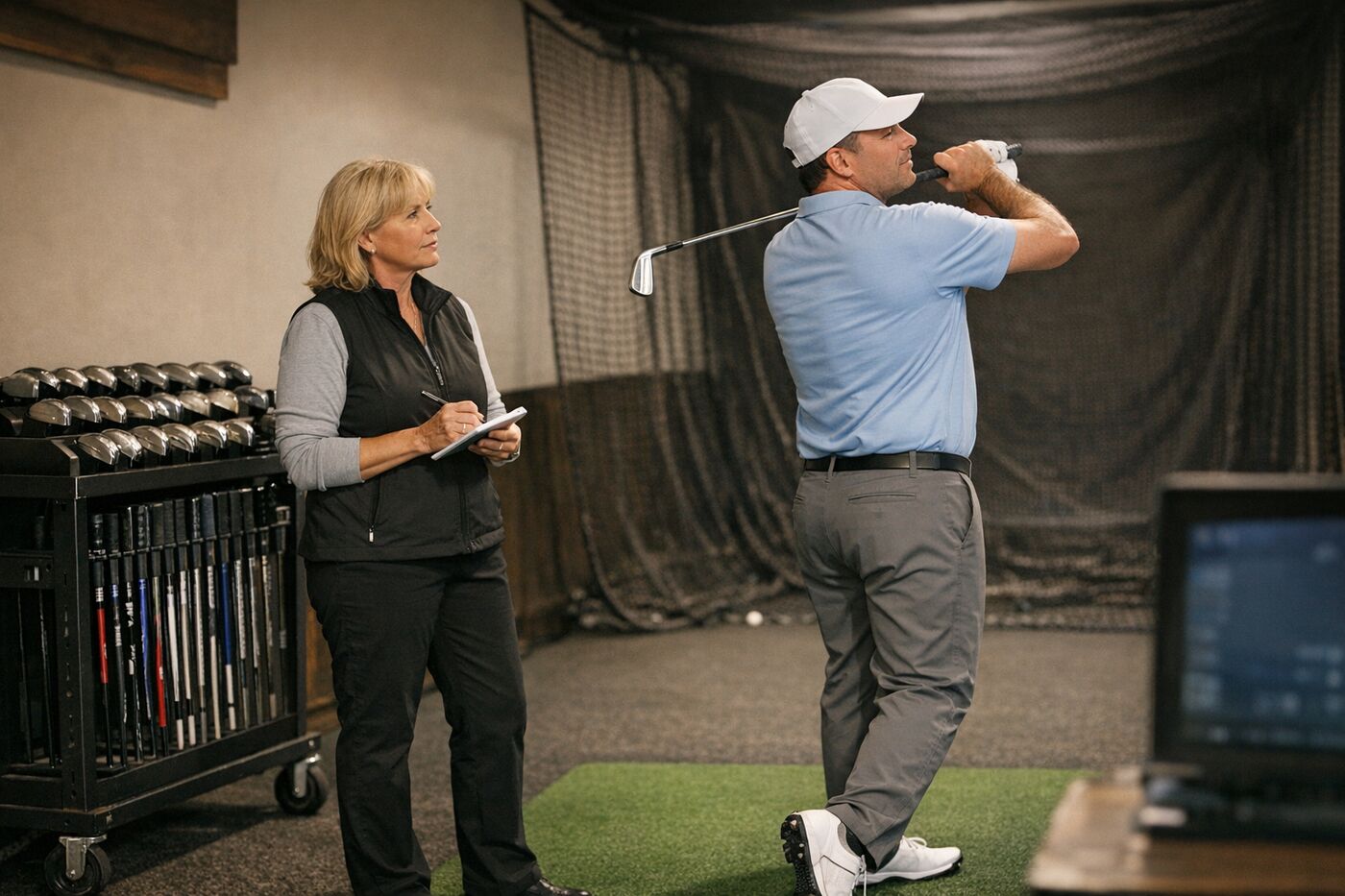
Plenty of golfers have been fit. A 2023 Golf Datatech study of serious golfers playing 16 or more rounds a year found nearly eight in ten had been through a fitting, and about 55 percent of the irons and drivers sold to them were custom fit [38]. Being fit and being fit well are not the same thing.
We don't have data comparing retail fittings with independent ones, and we won't pretend to. What we can describe is the difference in what each tends to focus on. A fitting attached to a single brand or to the inventory of a particular store naturally optimizes within that range, and the session usually centres on launch monitor numbers from a short burst of swings. A fitter who builds clubs measures and adjusts swingweight, total weight, length and moment of inertia, and can work with clubs you already own. That second kind of fitting is the one that addresses tempo.
That's why, for any real fitting work, we suggest looking for a member of the Association of Golf Clubfitting Professionals (AGCP). Here's why we think it's worth finding one:
- They test their members. AGCP certification runs on a level system, from a proficiency test up to a full shop with launch monitor analysis and the ability to build to swingweight and MOI specifications. They state, "We do not exempt anyone from our certification test" [37].
- They're clubfitters and builders, not a retail chain. The organization describes itself as a small, privately owned peer group of professional clubfitters that formed after the Professional Clubmakers' Society ended [36].
- There's a directory. You can search for an AGCP member near you on the AGCP directory [36].
In the spirit of our honesty principle, here's a disclosure. The AGCP says it is supported primarily by Wishon Golf and Diamond Golf, two companies that design and supply clubheads and components to fitters [36], and Tom Wishon is quoted earlier in this guide. GolfSalt has no relationship with the AGCP, Wishon Golf or Diamond Golf, and we earn nothing if you use their directory. We recommend AGCP fitters for their focus on measured, build-to-fit work, not for any brand.
Questions to ask any fitter, AGCP or not
- Will you measure the swingweight, total weight and length of the clubs I already have?
- Can you adjust my current clubs, or is this fitting only for buying new ones?
- Do you build or adjust to swingweight, or to MOI?
- How do you account for my tempo and transition, not just my clubhead speed?
- How many swings will you look at before deciding, and will you test when I'm a little tired?
- Are you limited to particular brands?
Music: for practice and before the round
We covered music in more depth in The Soundtrack of Better Golf, but it belongs in a tempo guide too, for two different jobs.

In practice: give your tempo a beat
Music helps movement because people naturally fall into step with a steady beat. Across 139 studies, music improved both how people felt and how they performed physically, with bigger effects in exercise than in sport, and with faster music [39]. Golf is a precision skill rather than an endurance one, so we use music for its beat rather than its energy.
Here's a simple way to use a song in practice. The arithmetic is ours, built on the frame counts above. In a song between about 110 and 130 beats per minute, count the half-beats ("one-and-two-and-three"). Start the club back on one, reach the top on the and after two, and strike on three. That's three half-beats back and one down, a 3:1 ratio, with a full swing of about 0.9 to 1.1 seconds, right in the range of the tour tempos above. For putting, start back on one, reach the top on two and strike on the and after two. That's 2:1. Faster songs give you a quicker tempo and slower songs a smoother one, and the ratio stays the same.
Make a short playlist of three or four songs at your tempo and use it only for practice. Over time, just hearing the first few bars becomes a cue that brings your rhythm with it. On the course, you can hum it.
Before the round: use music to set your state, not your score
Music before a performance can help regulate arousal and support imagery, and music you choose yourself tends to work best [42]. The honest golf-specific evidence is modest but useful. In 20 collegiate golfers, listening to self-selected music before a round lowered anxiety, but swing and putting performance didn't change [41]. Music can settle you. On its own it won't lower your score.
Choose by state. If you arrive anxious and rushed, which is when tempo gets quick, pick something calmer and slower than you'd normally choose. If you arrive flat and stiff on a cold morning, something more upbeat can lift you. Stimulating music raises arousal, and that can tip into tension if you're already wound up [40]. Then let the last song before you warm up be one of your practice tempo songs, so your rhythm comes with you to the range. If you're short on time, pair it with our warm-up for people who hate warming up.
A four-week tempo plan
| Week | Focus | What to do |
|---|---|---|
| 1 | Measure | Film 10 full swings with two clubs and 10 putts. Work out your ratio and how much it varies. Find your continuous-swing pace and your resonant putting pace. |
| 2 | Groove | Three short sessions with a metronome or tempo tones at your own speed, 3:1 for full swings and 2:1 for putts. Ten practice swings, ten balls, ten balls with the sound off. |
| 3 | Pressure | Keep the count, add stakes: small games, a scorecard, someone watching or a camera running. Check grip pressure on every shot. |
| 4 | Test and check the gear | Play a round with one goal: the same count on every shot. Film again and compare with week 1. If one or two clubs never feel right, have them measured. |
How GolfSalt approaches tempo
You don't need any app to do everything in this guide. A free metronome and your phone's camera cover the basics. If you do coach with GolfSalt, here's how tempo fits in.
- The Tempo Metronome and Swing Tones, with 3:1 full-swing and 2:1 short-game patterns, so you don't have to do the arithmetic. Pick a speed yourself, or let it use the tempo measured from your own filmed swings.
- Count-In Rhythm, one steady beat you count along with: count 1, 2, 3, start back on 3 and change direction on the next beat. It shows where its pace came from, including how long you tend to hold at the top.
- Swing video analysis and a Tempo Score. Your filmed swings are measured for backswing time, downswing time and ratio, alongside the key positions in your swing. The Tempo Score on your stats page tracks how repeatable that rhythm is over time, which is the thing this guide keeps coming back to.
- On Apple Watch, a tempo trainer that taps the rhythm on your wrist, so you can practice without earbuds or a phone in hand.
- A coach that connects the dots. Your coach sees your tempo work in your practice log alongside your rounds, your goals and your clubs' specifications. It can notice, for example, that your tempo drifted after an equipment change or falls apart in the last few holes. When the data points there, your practice plan includes tempo work.
It's one part of a coaching relationship that covers your whole game, not a tempo gadget. And it gets more useful the more you share with it.
Final thought
"Slow down" is the most common tempo advice in golf, and as we've seen, it's usually not quite right. Good tempo is a pace that suits you, with proportions you can repeat on the range, on the first tee, over a putt that matters, on the 16th when you're tired, and with clubs that fit the way you swing.
If you take one thing from the "couple of drinks" effect, take this: the smooth swing was already yours. Tension was hiding it. Find your ratio, give it a sound, practice it with a little pressure, make sure your equipment isn't fighting it, and you'll be able to find it again sober, nervous or tired.
Sources & References
- Grober, R.D. & Cholewicki, J. "Towards a Biomechanical Understanding of Tempo in the Golf Swing." arXiv, 2006. Link
- Grober, R.D. "Measuring Tempo, Rhythm, Timing, and the Torques that Generate Power in the Golf Swing." arXiv, 2010. Link
- Jagacinski, R.J. et al. "Tempo, Rhythm, and Aging in Golf." Journal of Motor Behavior, 1997. Link
- Tour Tempo (J. Novosel). Tour Tempo app listing, App Store. Link
- Laws, J. "Check Your Tempo." Australian Golf Digest, 2019. Link
- Grober, R.D. "Resonance in Putting." arXiv, 2009. Link
- Grober, R.D. "Resonance as a Means of Distance Control in Putting." arXiv, 2011. Link
- Tanaka, Y. & Sekiya, H. "The influence of audience and monetary reward on the putting kinematics of expert and novice golfers." Research Quarterly for Exercise and Sport, 2010. Link
- MIT Technology Review. "The secret of world class putting." 2009. Link
- Beilock, S.L. & Carr, T.H. "On the fragility of skilled performance: What governs choking under pressure?" Journal of Experimental Psychology: General, 2001. Link
- Mullen, R., Hardy, L. & Jones, G. "Knowledge and conscious control of motor actions under stress." British Journal of Psychology, 1996. Link
- Cooke, A. et al. "Effects of competitive pressure on expert performance: Underlying psychological, physiological, and kinematic mechanisms." Psychophysiology, 2011. Link
- Langlais, S.M. & Broker, J.P. "Grip pressure distributions and associated variability in golf." Sports Biomechanics, 2014. Link
- Bresin, K. "A meta-analytic review of laboratory studies testing the alcohol stress response dampening hypothesis." Psychology of Addictive Behaviors, 2019. Link
- Terry, P. et al. "Dissociations between motor timing, motor coordination, and time perception after the administration of alcohol or caffeine." Psychopharmacology, 2009. Link
- Vella, L.D. & Cameron-Smith, D. "Alcohol, athletic performance and recovery." Nutrients, 2010. Link
- Shirreffs, S.M. & Maughan, R.J. "The effect of alcohol on athletic performance." Current Sports Medicine Reports, 2006. Link
- World Archery. "Statement on WADA's withdrawal of alcohol from banned substances list." 2017. Link
- McGurrin, P. et al. "Objective response to ethanol in essential tremor." Annals of Clinical and Translational Neurology, 2024. Link
- Swisher, J. et al. "Epidemiology of Golf-Related Injuries Presenting to US Emergency Departments and the Impact of Alcohol." Clinical Journal of Sport Medicine, 2025. Link
- Sommer, M. & Rönnqvist, L. "Improved Motor-Timing: Effects of Synchronized Metronome Training on Golf Shot Accuracy." Journal of Sports Science and Medicine, 2009. Link
- Sommer, M., Häger, C. & Rönnqvist, L. "Synchronized metronome training induces changes in the kinematic properties of the golf swing." Sports Biomechanics, 2014. Link
- Kim, J.H. et al. "Training effects of Interactive Metronome on golf performance and brain activity in professional woman golf players." Human Movement Science, 2018. Link
- Bieńkiewicz, M.M.N. et al. "Learning Golf Putting Through Auditory and Visual Guidance." Frontiers in Psychology, 2019. Link
- Global Golf Post / NBC Sports. "Orange Whip keeps golfers in rhythm." 2012. Link
- Mori, K. et al. "Effects of two-step golf swing drills on rhythm and clubhead speed." Sports Biomechanics, 2025. Link
- Wishon Golf. "Swingweight – The Ideal Swing Reference Point." 2012. Link
- Wishon Golf. "Why MOI Matching Is Important to Your Golf Game." 2012. Link
- TGW. "What Is Swing Weight?" Link
- Adams, R.W. US Patent 1,953,916, "Golf club balance scale." 1934. Link
- Barath, R. "What is golf club swing weight and why does it matter?" GOLF.com, 2024. Link
- Cross, R. & Bower, R. "Effects of swing-weight on swing speed and racket power." Journal of Sports Sciences, 2006. Link
- Schorah, D. et al. "Effects of moment of inertia on restricted motion swing speed." Sports Biomechanics, 2015. Link
- Yang, C.C. et al. "The effects of different iron shaft weights on golf swing performance." Frontiers in Bioengineering and Biotechnology, 2024. Link
- Kenny, I.C. et al. "Influence of shaft length on golf driving performance." Sports Biomechanics, 2008. Link
- Association of Golf Clubfitting Professionals. "What is the AGCP?" and member directory. Link
- Association of Golf Clubfitting Professionals. "Certification Requirements for AGCP Member Qualification Levels." Link
- Stachura, M. "New study reveals one thing that helped 90 percent of avid golfers" (Golf Datatech fitting study). Australian Golf Digest, 2023. Link
- Terry, P.C., Karageorghis, C.I. et al. "Effects of music in exercise and sport: A meta-analytic review." Psychological Bulletin, 2020. Link
- Karageorghis, C.I. & Priest, D.L. "Music in the exercise domain: a review and synthesis (Part I)." International Review of Sport and Exercise Psychology, 2012. Link
- Wang, H.T. et al. "Acute Effects of Self-Selected Music Intervention on Golf Performance and Anxiety Level in Collegiate Golfers." International Journal of Environmental Research and Public Health, 2020. Link
- Karageorghis, C.I. & Priest, D.L. "Music in the exercise domain: a review and synthesis (Part II)." International Review of Sport and Exercise Psychology, 2012. Link